Across a portfolio of 12 stores, a single delayed repair in facilities maintenance can ripple into customer disruption, safety risk, and a spike in emergency spending. In multi-site environments, the gap between intent and execution compounds across locations, service providers, and asset types, and it tends to show up first as a work order that slipped, a repair that was never documented, or a service provider who arrived without the right context.
This blog explains how facilities maintenance at scale can stay predictable even when sites, providers, and schedules diverge. You will learn why a CMMS matters for both facility managers and building service contractors, how four pillars of capability come together in one platform, and a fast path to onboarding that keeps results like a large, fast-growing mixed-use real estate owner-operator 's within reach for others. We will touch on enterprise workflow, contractor network management, and procurement during day-to-day operations, with concrete steps you can apply in 30 days.
A large, fast-growing mixed-use real estate owner-operator onboarded to the myWork platform in 30 days, and they are just one example of how this approach scales across 10M+ work orders and 190,000+ North American locations on myWork. In the sections that follow, you will see how to apply this to retail and QSR, commercial real estate, healthcare, and BSC operations, and how to start with a fast onboarding path.
At scale, facilities maintenance requires real-time visibility across locations of operational truth for assets and tasks. When 10, 50, or 500 sites stop operating with separate spreadsheets and paper work orders and utilize a modern, intelligent CMMS platform:
Key insights you can act on today center on consolidating data, standardizing processes, and giving field teams a common interface. The result goes beyond being just a product, but a system that aligns planning, scheduling, and procurement with actual on-site execution. This approach is what myWork delivers when you pair a robust work order engine with your pre-vetted contractor network and a procurement backbone.
Key insight: At scale, the right data architecture matters as much as the right tools.
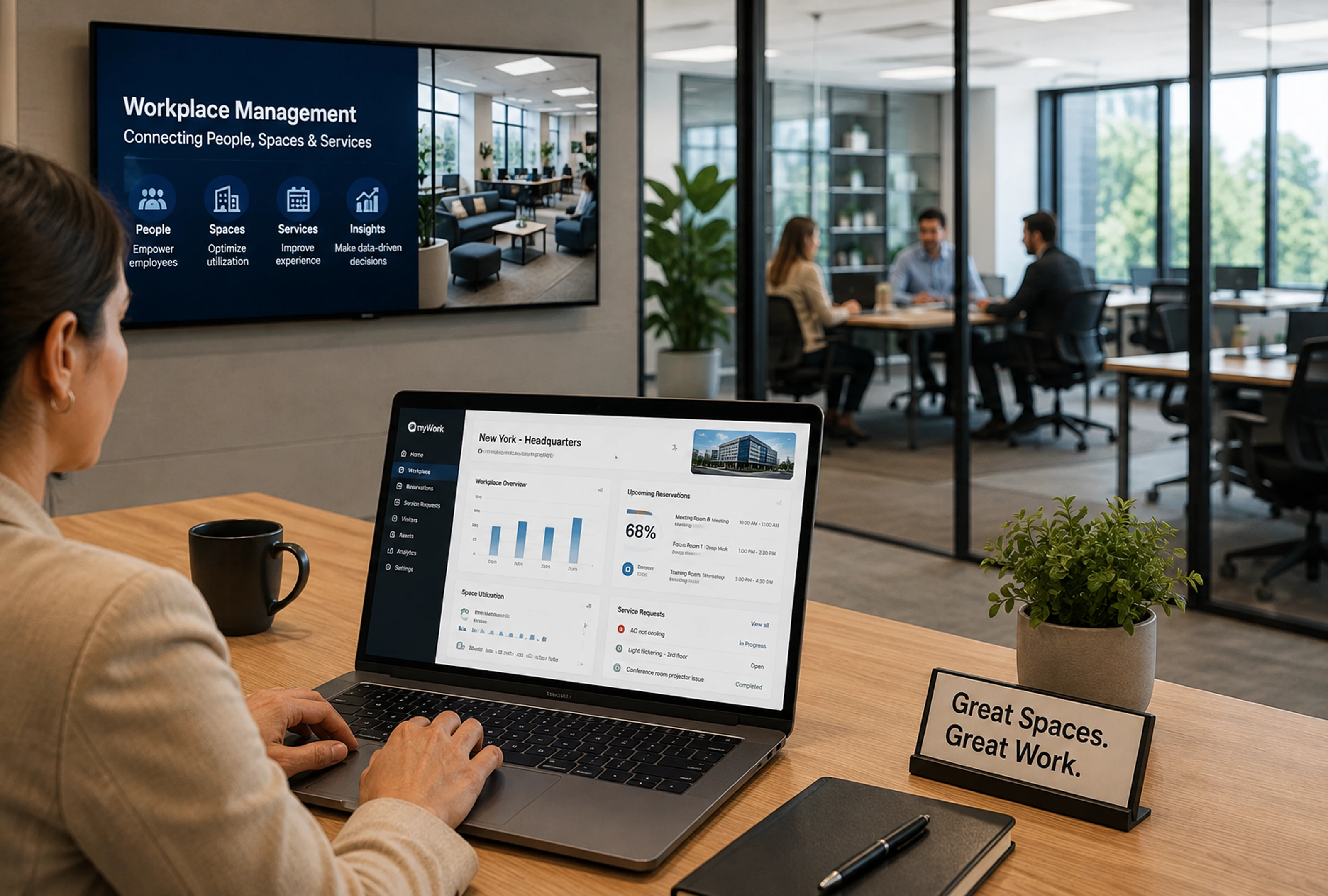
Reactive maintenance can seem cheaper in the moment but often extracts a heavy toll over time. Downtime, overtime, rushed provider scheduling, and non-compliant paperwork can degrade occupant and end customer experience.
The challenge is turning intention into a repeatable rhythm across locations and service providers. A truly scalable facilities maintenance approach uses a centralized calendar, standardized PM tasks, and a provider network accessible from a single interface. With myWork, that approach is embedded into the platform. You can track preventive maintenance campaigns across all sites, align with service level agreements, and quantify savings from fewer emergency repairs.
A common mistake: Treating maintenance as a collection of one-off tasks rather than a continuous program with standardized PM schedules and provider partnerships.
The core value proposition for a multi-site operator is a single platform that unifies planning, field execution, and procurement. myWork is built on a native CRM, AI, automation, reporting, and full ecosystem integration.

One direct outcome of this architecture is the enabling of cross-functional teams to access CRM data, asset histories, and service records within the same system.
This is important for large operators who must demonstrate compliance to regulators and internal stakeholders while maintaining a high level of service. It also enables automation and data-driven insights that can help identify patterns before a failure occurs, improving both reliability and uptime.
Direct answer: A connected and intelligent CMMS can unify planning, execution, and procurement into a single, scalable system for facilities maintenance across many sites.
Market signal: Enterprise-scale operators increasingly demand platforms that connect salesforce with CRM, analytics, and procurement. myWork delivers that integration without expensive custom builds.
In practice, multi-site operators using this approach often report faster onboarding, better data hygiene, and measurable reductions in unplanned downtime. A large, fast-growing mixed-use real estate owner-operator is an example of how quickly value can be realized, they were fully onboarded and operational on myWork within 30 days.
Across the network, the system processes tens of millions of work orders, supports 190,000+ locations, and taps into a network of 73,000+ pre-vetted BSCs.
The practical impact across verticals like retail, restaurants, QSR, commercial real estate, and healthcare includes more predictable maintenance cycles, faster fulfillment of service requests, and stronger regulatory compliance documentation. You also gain an auditable trail for each service event, which matters for audits, insurance, and franchise requirements. myWork Supply can reduce last-minute purchases.
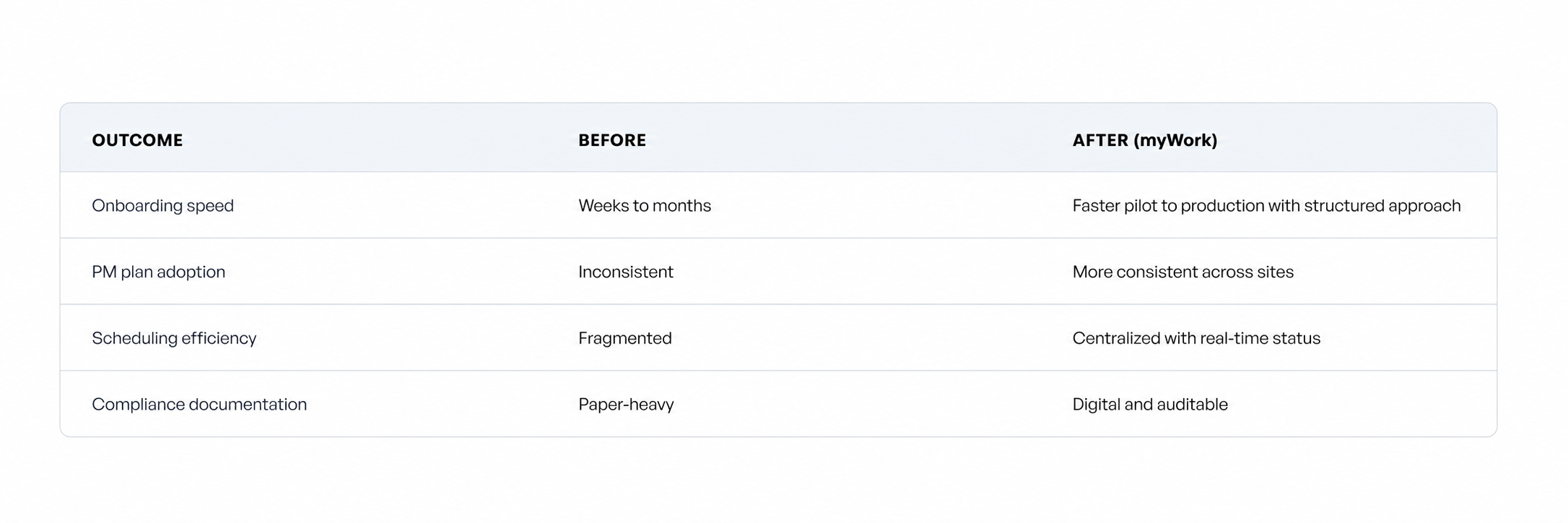
A common mistake: Failing to leverage a operational truth across asset data, PM schedules, and provider performance leads to fragmented reporting and missed optimization opportunities.
A practical path begins with mapping locations, critical assets, and top PM tasks per site, then onboarding in waves with templates and playbooks built for multi-site operations. You can start with core capabilities and scale to full procurement and service provider network integration as your program matures.
Key actions you can implement this quarter include aligning on a standard PM schedule, consolidating work orders into a single queue, and ensuring field teams have offline capability to operate at sites with poor connectivity. The two-sided platform model helps both facility managers and BSCs share data and custody of service proof, which can reduce disputes and accelerate payments.
Key insight: A staged onboarding plan that starts with critical assets and a small pilot typically yields faster time to value and reduces risk.
Market signal: Industry operators increasingly expect digital proof of service and real-time status updates as part of enterprise-grade facilities maintenance.
Facilities maintenance at scale demands a deliberate, data-driven approach that aligns planning, field execution, and procurement across dozens or hundreds of sites. A CMMS that brings together myWork Enterprise embedded with myWork Supply can deliver consistency, speed, and measurable outcomes across multi-site portfolios.
The two-sided platform benefits both facility managers and building service contractors by aligning data, schedules, and proofs of service into a single, auditable workflow. If your portfolio is growing beyond a handful of locations and you want to move from reactive firefighting to a preventive rhythm, consider exploring a fast onboarding path with myWork at https://www.mywork.one/.
With a platform that already supports 10M+ work orders and 190,000+ locations, and a network of 73,000+ pre-vetted BSCs, you can move toward more predictable maintenance outcomes.
What is facilities maintenance in practical terms?
Facilities maintenance is the ongoing care of building systems, equipment, and spaces to keep operations safe, compliant, and reliable. It includes preventive maintenance, planned corrective work, and service provider-managed services across multiple sites.
How can an intelligent, field-first CMMS help multi-site operators?
It delivers integrated salesforce, CRM, and procurement workflows in one platform. It enables real-time visibility, standardized PMs, a pre-vetted contractor network, and data sharing across locations and teams.
What is the ROI of preventive maintenance for multi-site operations?
Well-planned preventive maintenance can reduce emergency repairs, and extend asset life. While exact ROI varies by portfolio, many operators see faster issue detection, fewer unplanned outages, and more predictable reduced budgets.
How long does it take to implement myWork for 10 to 50 sites?
Structured implementations commonly take 30 to 90 days, depending on data readiness, integrations, workflow complexity, training, and rollout scope. Core workflows can go live faster when the platform fits the operating model and the implementation is well prepared. A large, fast-growing mixed-use real estate owner-operator was fully operational within 30 days, which reflects what is achievable with a close fit between the platform and the operational model.
Is facilities maintenance software suitable for retail, QSR, CRE, healthcare, and BSC operations?
Yes. Multi-site operators across these verticals can benefit from unified work orders, asset data, procurement, and service provider management, enabling consistent service, better regulatory compliance, and scalable growth.