With workplace management the challenge is not just keeping lights on or maintaining HVAC, it is orchestrating people, spaces, and assets across geographies with consistent standards and auditable data.
In practice, this means turning a legacy mix of service calls, spreadsheets, and paper checklists into a single, transparent operating system. For most multi-site operators, the gap is not awareness of what good maintenance looks like, it is building the execution infrastructure to deliver it consistently across every location. That gap between intent and delivery is a defining pain point for multi-site facility management and BSC operations.
myWork lays out a practical framework for understanding workplace management, why myWork Enterprise embedded with myWork Supply matters, and how to execute at scale without chaos. You will see how building on Salesforce amplifies CRM, AI, and reporting to get you from reactive firefighting to proactive, measurable performance.
A large, fast-growing mixed-use real estate owner-operator, Wendy's, BrightView, and Cushman & Wakefield are among the clients who have leveraged this approach, with the owner-operator fully onboarded within 30 days. Over the next sections, we will define the scope, explain the differentiators, and provide a concrete rollout blueprint that your team can start using this quarter.
Workplace management is not a single feature, it is a discipline that ties together people, processes, and data to deliver consistent results across locations.
Workplace management encompasses the end-to-end lifecycle of facilities and spaces across locations. It is not just about fixing broken equipment, it is about coordinating preventive maintenance, asset lifecycles, service provider performance, space planning, and regulatory compliance in a way that is auditable and scalable.
For multi-site operators in commercial real estate and retail, this means translating local site needs into standardized processes that work the same at the first store and the hundredth. The core components include asset and location records, preventive maintenance calendars, work order management, provider and contract oversight, space and asset planning, and regulatory documentation.
When these elements are connected, teams can gain real-time insight into what is happening where, who is responsible, and how to improve outcomes across the portfolio.
A centralized system can reduce duplication of work and create an operational truth for all maintenance activities.
The right platform helps you standardize safety documentation, warranty tracking, and energy and sustainability reporting across locations. It also enables you to measure performance against consistent targets rather than relying on fragmented, site-by-site reporting.
Key insight: Centralized data across locations can reduce duplicate work and speed decision-making.
Common mistake: Relying on scattered communication channels for field updates can create blind spots and delays.
Market signal: According to myWork platform data, multi-site operators with centralized workflows tend to report faster issue resolution and higher audit pass rates.
What is workplace management when you add myWork Enterprise with integrated supply and provider capabilities? The answer is not simply a better maintenance system. It is a combined capability set that can remove handoffs between facilities teams, procurement, and service providers.
Mywork utilizes a Salesforce foundation to automate routine tasks, reduce overhead, improve first-time fix rate, deliver accurate faster responses, clearer communication, and real-time reporting.
For a portfolio spanning 180 sites, this can mean a single data model, a single automation layer, and a single user experience across facility managers and the service providers who support them. In practice, that can translate to faster onboarding, more accurate forecasting, and improved provider accountability.
The myWork Supply module’s features are important differentiators for operators who manage large provider ecosystems. The ability to procure, track, and verify services within the same system can reduce procurement cycle times, enable consolidated reporting, and strengthen ESG and sustainability reporting for the entire portfolio.
This is especially relevant in multi-site healthcare, commercial real estate, and retail where compliance demands, energy performance, and provider practices drive decision-making.
myWork Enterprise also includes fully offline mobile capability that keeps field teams productive when connectivity is intermittent, important for remote locations and large building sites.
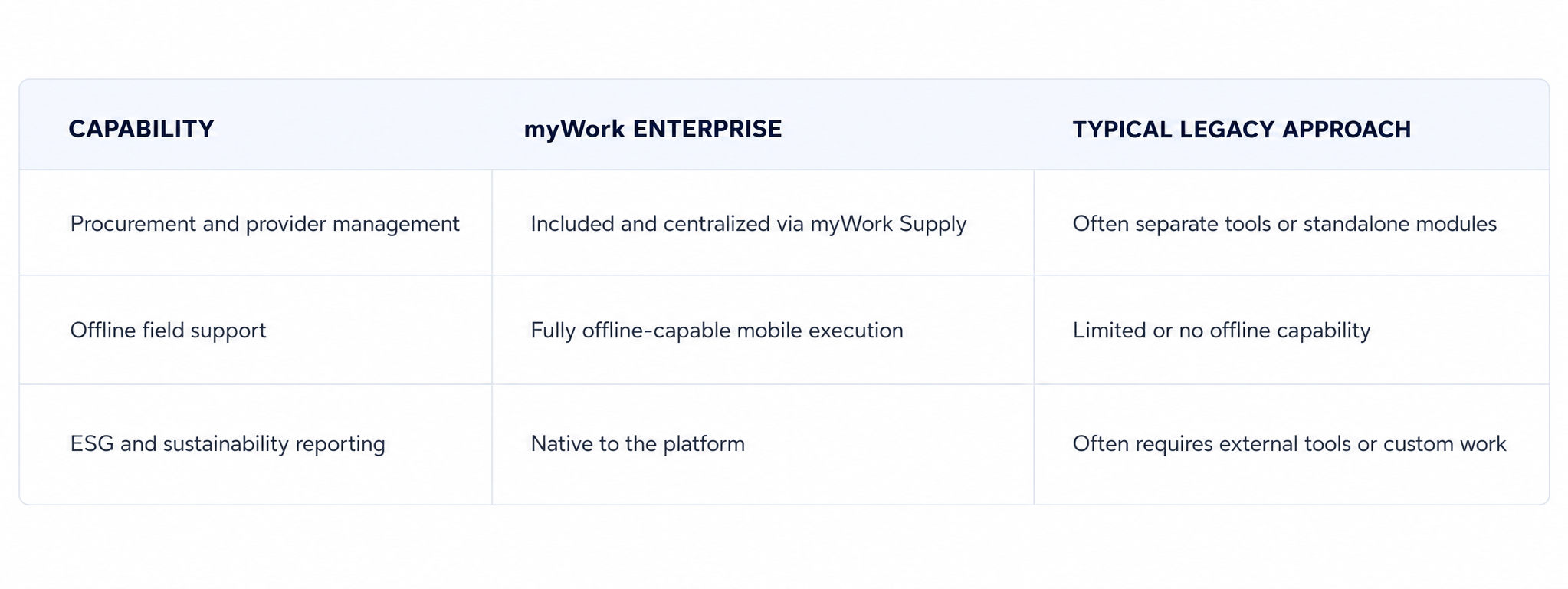
The operating model can become more predictable when you link maintenance activities to procurement and provider performance in one place. A common pattern is to onboard key sites first, run preventive maintenance programs aligned to OEM guidance, and then expand to full portfolio governance.
The large, fast-growing mixed-use real estate owner-operator case illustrates this: fully onboarded and operational within 30 days, with governance and reporting in place to support multi-site oversight.
Common mistake: Treating procurement as a separate process from maintenance can lead to misaligned priorities.
Market signal: Facility teams increasingly expect one platform to cover maintenance and procurement to meet audit and ESG requirements, according to myWork data.
Moving from pilot to a full-scale rollout across 5, 500, or 1,000+ locations requires a disciplined approach. Map existing workflows to a standard operating model, then configure myWork Enterprise to mirror those flows.
Training is important, but the real differentiator is governance: a clear decision-rights framework and a rhythm for ongoing optimization. Structured implementations commonly take 30 to 90 days, depending on data readiness, integrations, workflow complexity, training, and rollout scope. Core workflows can go live faster when the platform fits the operating model and the implementation is well prepared. A large, fast-growing mixed-use real estate owner-operator was fully operational within 30 days, which reflects what is achievable with a close fit between the platform and the operational model.
Step 1: Define the target state and quantify expected outcomes in terms of uptime, compliance, and procurement cycle time.
Step 2: Build a governance model that includes facilities leaders, procurement, and BSC partners.
Step 3: Roll out across the portfolio in waves, using repeatable templates and playbooks.
Step 4: Ensure minimal training required through intuitive UI for both facility managers and BSC staff.
Step 5: Establish a continuous improvement loop with monthly reviews of KPI trends and provider performance.
Pilot to scale pattern:
Key insight: Applying a repeatable rollout pattern across sites can reduce implementation time and accelerate time to value.
Common mistake: Rolling out without a governance layer can lead to inconsistent data and misaligned expectations across teams.
Market signal: Enterprise buyers increasingly demand a unified platform with procurement and service provider management to meet multi-site governance requirements, according to myWork data.
The bottom line in workplace management is what you can verify and improve over time. With myWork Enterprise with integrated myWork Supply, operators can track operational health through a set of leading and lagging indicators.
Top-line metrics include asset uptime, PM completion rates, schedule adherence, and the reduction of reactive work orders. Better data quality can improve forecasting, enabling better budget planning and provider negotiations. This can translate into reduced emergency outages, and stronger audit readiness.
According to myWork data, organizations using myWork Enterprise embedded with myWork Supply see faster procurement cycles and higher service provider accountability, which can correlate with improved facility uptime.
Direct answer: Workplace management in practice is a disciplined approach to coordinating assets, spaces, and service delivery at scale using a unified platform that combines maintenance, procurement, and data analytics.
Common mistake: Focusing only on ticketing or a single module can ignore the efficiency gains from cross-functional workflows and provider governance.
Market signal: Clients with multi-site portfolios increasingly demand a platform that can handle both facility operations and service provider management without switching tools, according to myWork platform data.
Workplace management becomes a practical reality when you move from siloed maintenance and procurement practices to a unified, data-driven operating model.
You can start with a focused pilot and, with a scalable governance model, expand to the full portfolio with confidence. The outcome can be more predictable uptime, compliant operations, and a better experience for building service contractors who value clarity and speed. If your team manages multiple locations and is ready to move from reactive to preventive operations, scheduling a demo at https://www.mywork.one/ is a practical next step.
What is workplace management in simple terms?
In simple terms, it is the set of processes that coordinate people, assets, spaces, and tasks across multiple sites to deliver consistent performance and compliance.
How does workplace management relate to IWMS?
An IWMS focuses on integrated workplace management. Workplace management is the broader discipline that can be supported by specialized CMMS and provider governance within a platform.
What is IWMS software?
IWMS software integrates facilities management functions including space planning, maintenance, and operations into one system. It is often used to optimize real estate portfolios.
What is myWork supply?
myWork Supply handles procurement of parts and materials, connecting supply chain activity to maintenance cycles, within myWork Enterprise.
How long does it take to implement at scale?
Structured implementations commonly take 30 to 90 days, depending on data readiness, integrations, workflow complexity, training, and rollout scope. Core workflows can go live faster when the platform fits the operating model and the implementation is well prepared.
Is workplace management suitable for mid-sized portfolios?
Yes. Multi-site portfolios of 5, 500, or 1,000+ locations can benefit from centralized data, cross-site workflows, and unified provider governance.