Managing physical assets across 10 locations is quite different than managing them across 500. As portfolios grow, the gap between what gets planned and what actually gets executed tends to widen, showing up as budget overruns, inconsistent service levels, and compliance risks that are difficult to catch before they escalate.
myWork explains enterprise asset management as a discipline, clarifies why legacy tools can struggle at scale, and shows how myWork Enterprise closes that gap for facilities teams. You will see how a real multi-site portfolio benefits from integrated asset data, real-time work order visibility, and a service provider network that actually scales.
You will also learn how a large, fast-growing mixed-use real estate owner-operator was fully onboarded and operational on myWork within 30 days, and how myWork Supply fits into the EAM picture. The insight you will leave with is practical, actionable, and anchored in real-world outcomes.
EAM is the discipline of managing physical assets through their complete lifecycle to maximize uptime. In practice for facilities, EAM focuses on buildings, equipment, and grounds that you operate across multiple sites. It blends asset records, preventive maintenance, work orders, procurement, and service provider management into one cross-site workflow. The objective is to align asset performance with service level expectations.
EAM software differs from traditional asset management by emphasizing the end-to-end lifecycle of assets within a built environment. It covers planning, acquisition, operation, maintenance, and replacement decisions.
In multi-site portfolios, data fragmentation is often the enemy. Asset histories, provider data, and maintenance calendars can sit in silos across locations. EAM unifies these threads so leadership can answer: which assets are critical to service.
The facility lens adds unique requirements. Maintenance may involve diverse asset classes across retail, healthcare, and commercial real estate properties. Space utilization, tenant impact, regulatory compliance, and service level agreements demand a holistic approach to asset performance.
Key insight: EAM software for facilities is not the same as EAM for manufacturing. The lifecycle dynamics, maintenance cycles, and service provider ecosystems differ, and your software should reflect those realities rather than repurpose a manufacturing-oriented framework.
myWork can access CRM data and service data in the same place, which can improve accountability and coordination across site teams and providers.
A common mistake: Treating EAM as a pure maintenance scheduling tool often ignores the broader lifecycle economics and provider governance needed to run a distributed portfolio effectively.
Core capabilities to look for in an EAM for facilities:
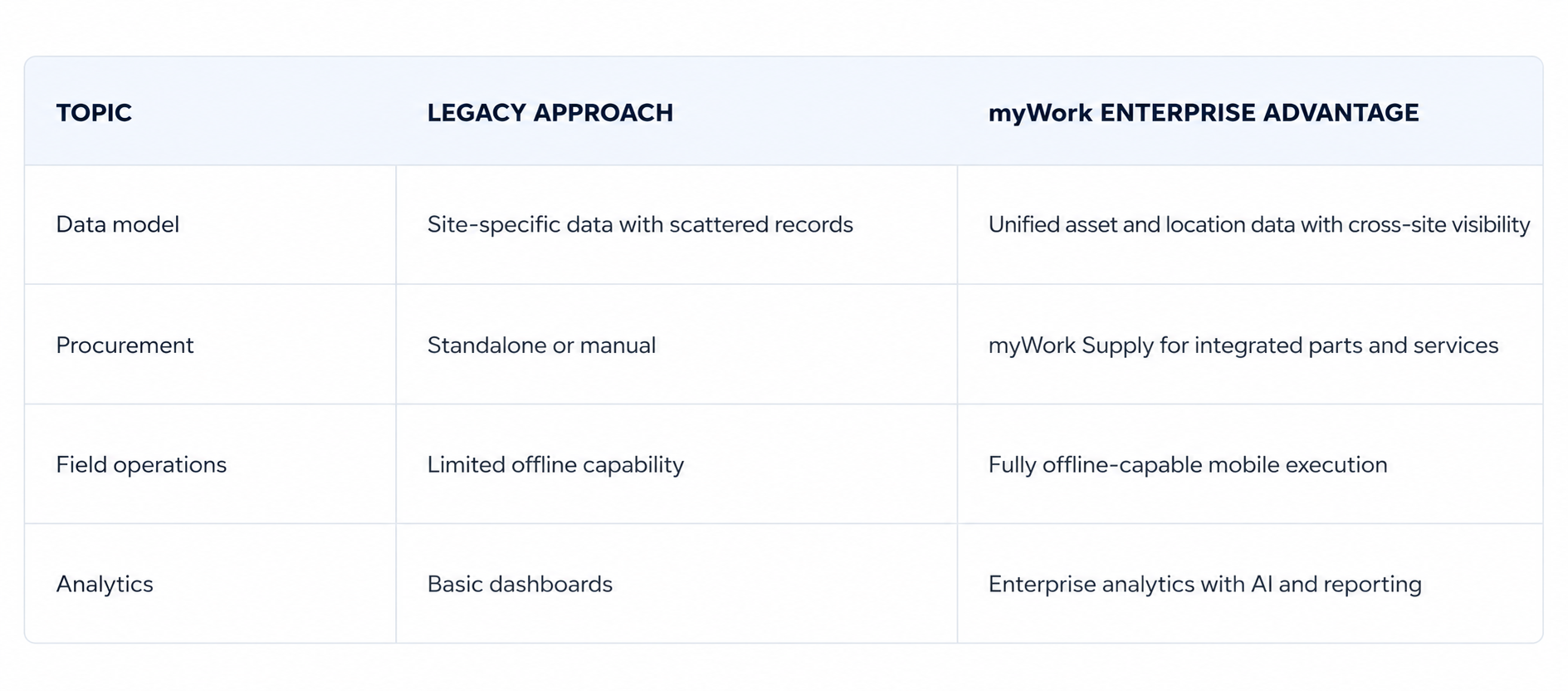
Market signal: Industry observers increasingly prioritize platforms that scale across locations while delivering ERP-level visibility. The shift toward salesforce-based EAM aligns with broader demand for CRM-aligned field operations and provider collaboration.
Legacy CMMS platforms were often originally built for single sites or narrow use cases and then stretched to multi-site operation. The result can be brittle governance, inconsistent data, and slow, error-prone workflows as you add sites and service providers. When you reach just 5 to 10 locations, these tools may require heavy customization, long implementation timelines, and expensive integrations. Even larger, more robust CMMS systems have the same issues around configuring and customizing for specific industries and individual companies.
A common mistake: Underestimating the importance of integrated procurement and provider data in the same system as asset and work order data can lead to procurement challenges and late invoicing, especially across multi-site portfolios.
A common mistake: Many teams try to bolt procurement modules onto a basic CMMS and end up with inconsistent parts data and slow invoice cycles.
The right platform can reduce rework by surfacing asset risk before it becomes a failure, enabling proactive maintenance that aligns with capital planning. A unified system can help you standardize maintenance protocols across sites while preserving local site flexibility.
Enterprise asset management for facilities brings asset data into one operating model and ties it to field operations, provider management, and procurement. myWork Enterprise is designed specifically for facilities and multi-site property management.
Two-sided platform for both facility managers and BSCs. The platform serves the facility management team that buys and maintains assets and the building service contractor network that performs the work. This can reduce handoff issues and improve visibility for both sides.
myWork Supply is embedded. When myWork Supply is incorporated into myWork Enterprise, you procure parts and services directly in the same system where you plan and execute maintenance.
Robust Platform. You gain unified data, advanced analytics, and AI-driven insights across the portfolio. The result can be smarter decisions about maintenance budgets, lifecycle investments, and service level performance.
Offline-capable field operations. myWork Enterprise includes fully offline mobile capability, ensuring technicians can complete work orders and capture data even when connectivity is poor or unavailable in the field.
Scale-ready governance. With an operational truth for assets, locations, parts, and service providers, your governance model can scale as you add sites and providers.
Real-time dispatch and work order management. The Dispatch Board keeps all work moving in real time and helps you balance workload across locations and crews.
Comprehensive asset lifecycle management. From acquisition to disposal and replacement planning, you can align capital decisions with maintenance funding and service levels.
ESG-aligned reporting. The platform supports sustainability data collection and reporting across the supply chain, enabling responsible procurement and facility operations.
A large, fast-growing mixed-use real estate owner-operator was fully onboarded and operational on myWork within 30 days, illustrating how a well-structured EAM approach can reduce risk and accelerate time to value for multi-site portfolios.
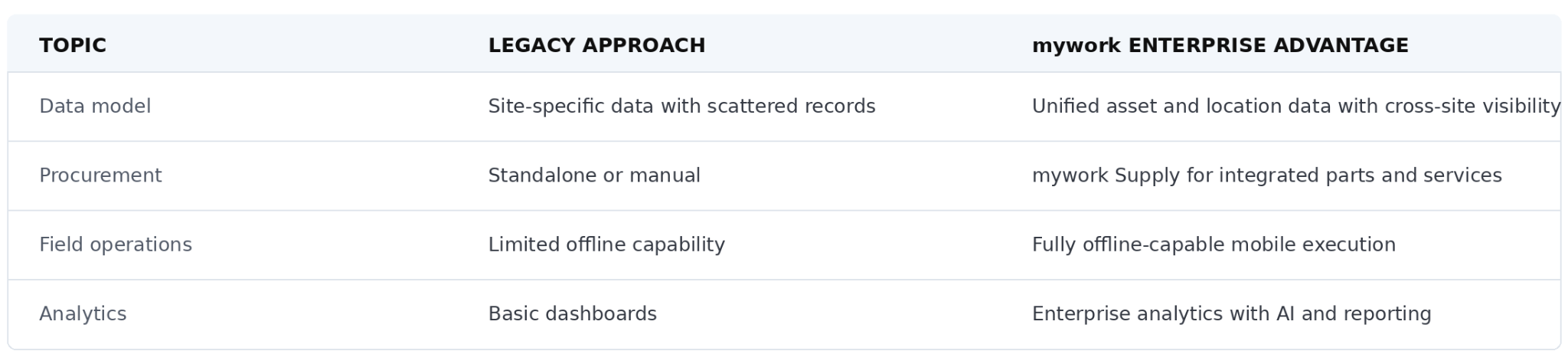
Market signal: Multi-site operators increasingly demand procurement-aware maintenance and integrated provider networks as core requirements rather than optional add-ons.
Implementing enterprise asset management for facilities across a portfolio requires a disciplined, staged approach. A practical blueprint begins with a baseline asset registry and then expands to preventive maintenance, work orders, and provider integration.
Structured implementations commonly take 30 to 90 days, depending on data readiness, integrations, workflow complexity, training, and rollout scope. Core workflows can go live faster when the platform fits the operating model and the implementation is well prepared. A large, fast-growing mixed-use real estate owner-operator was fully operational within 30 days, which reflects what is achievable with a close fit between the platform and the operational model.
Phase 1 — Baseline: Create a core asset registry across all sites, map critical assets, and establish a standard maintenance calendar. Align service level expectations with site leaders.
Phase 2 — Automation: Deploy preventive maintenance plans tied to asset criticality, configure dispatch rules, and enable offline field operations for technicians.
Phase 3 — Training and go-live: Roll out training for facilities managers, site supervisors, and BSCs; go live with a small pilot across a subset of sites, then scale.
Operational outcomes to work toward after implementation:
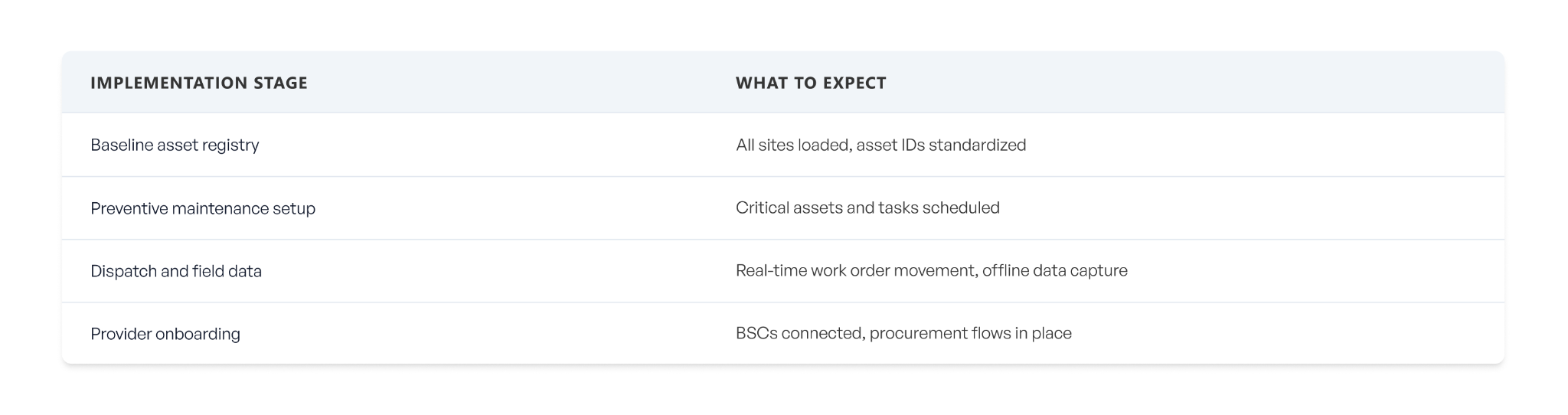
Market signal: The CMMS market is increasingly driven by multi-site scale and ERP-level integration, signaling a move toward enterprise-grade platforms for facilities.
Getting started with enterprise asset management for multi-site facilities is a practical, repeatable process. myWork accelerates onboarding and reduces risk by providing an operational truth for assets, locations, and service behavior.
Step 1 — Define portfolio goals. Decide which metrics matter most across sites: uptime, maintenance, compliance pass rates, and provider performance.
Step 2 — Create a unified asset registry. Import asset data across sites, assign locations, and set asset criticality to drive maintenance strategy.
Step 3 — Standardize maintenance programs. Build a set of preventive maintenance tasks applicable across the portfolio, while allowing site-level variations where necessary.
Step 4 — Train and go live. Run a controlled pilot across a subset of sites, monitor early outcomes, and refine processes before full rollout.
When myWork Enterprise is embedded with the myWork Supply module, the platform enables parts procurement and service procurement data to feed into forecasts and capital planning.
Timeline snapshot for a realistic portfolio:
A mature approach to enterprise asset management for multi-site facilities is about more than scheduling. It is about aligning asset performance with service commitments, provider governance, and the data that drives smarter decisions.
myWork unifies assets, location, and service data in one platform so you can labor efficiently, manage service providers at scale, and maintain compliance across every location.
Value can be realized quickly when the platform is designed for facilities rather than manufacturing. If your portfolio spans many sites and you want real-time visibility, scalable governance, and a modern integrated EAM approach, schedule a demo at https://www.mywork.one/
What is enterprise asset management in facilities management?
Enterprise asset management in facilities is the discipline of managing the full lifecycle of physical assets across a multi-site portfolio to maximize uptime. It combines asset data, maintenance planning, work orders, procurement, and service provider management into one integrated system.
How does EAM differ from CMMS?
A CMMS focuses on work order capture and maintenance tasks, often for a single site or limited scope. EAM expands beyond maintenance to lifecycle decisions, asset criticality, capital planning, and provider governance across multiple sites.
What industries benefit most from enterprise asset management in a portfolio context?
Commercial real estate, retail and QSR, healthcare, restaurant, and other multi-site operators can benefit significantly. These sectors rely on consistent service levels, regulatory compliance across many locations.
How long does implementation typically take?
Structured implementations commonly take 30 to 90 days, depending on data readiness, integrations, workflow complexity, training, and rollout scope. Core workflows can go live faster when the platform fits the operating model and the implementation is well prepared. A large, fast-growing mixed-use real estate owner-operator was fully operational within 30 days, which reflects what is achievable with a close fit between the platform and the operational model.
What is the business benefit of enterprise asset management for multi-site portfolios?
ROI can come from reduced downtime, improved maintenance planning, streamlined procurement, and better provider governance. In practice, operators often see more predictable budgets, faster issue resolution, and stronger compliance results across locations.