
90% of maintenance teams say preventive maintenance is very or extremely valuable, yet only about half plan most of their maintenance activities ahead of time. That gap is not a knowledge problem. It is an execution problem, and it shows up as emergency repairs, blown budgets, and audit trails full of holes.
If you manage 5 to 500+ locations, you have felt this. Work orders disappearing into email threads. Vendors showing up without the right parts. A compliance audit revealing documentation that should have been filed three months ago. This is what reactive maintenance looks like at scale, and it is what CMMS is designed to fix.
CMMS, Computerized Maintenance Management Systems, centralize work orders, schedule maintenance, manage assets, coordinate vendors, and maintain compliance documentation across every location in a portfolio. This guide explains what CMMS is, why multi-site operators need it, what to look for in a platform, and what real-world implementation looks like. Everything here draws from mywork's experience processing 10M+ work orders across 190,000+ North American locations, supported by a network of 73,000+ pre-vetted building service contractors.
• CMMS is a software platform that centralizes work orders, preventive maintenance, asset data, vendor coordination, and compliance documentation across locations.
• For multi-site operators, CMMS replaces reactive firefighting with structured, planned, and auditable maintenance programs.
• mywork is the only CMMS built natively on Salesforce Field Service, delivering CRM, AI, automation, and procurement in one platform.
• The right CMMS serves both facility managers and their contractors. Platforms that only serve one side create blind spots.
• RMS Investment Group was fully operational on mywork within 30 days. Implementation speed depends on architecture fit and data readiness.
• ROI comes from reduced downtime, lower admin overhead, stronger SLA compliance, and better procurement control.
A CMMS is a software platform that centralizes maintenance operations across multiple locations. It manages the full lifecycle of a maintenance request from the moment a problem is reported through dispatch, execution, documentation, invoicing, and reporting.
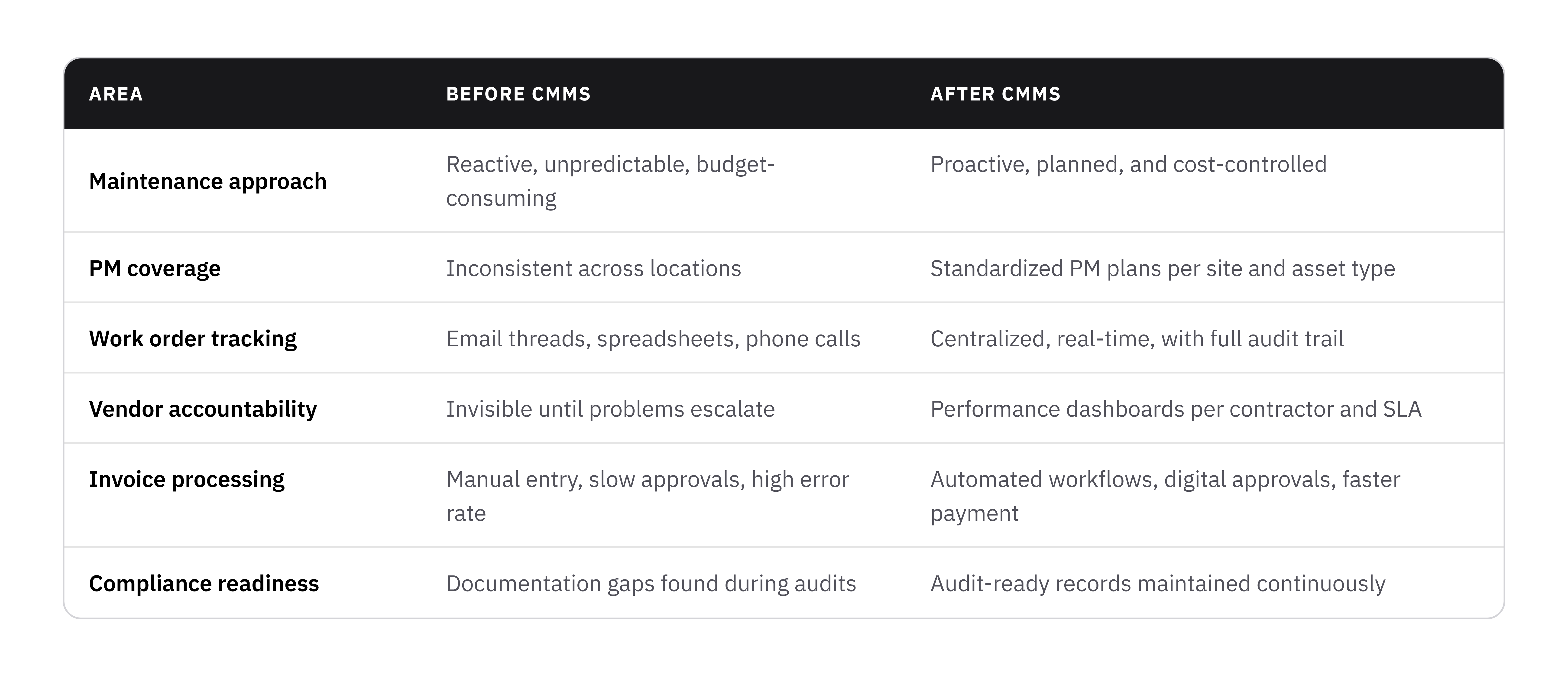
In practice, CMMS transforms maintenance from a series of ad hoc reactions into a structured, auditable, and optimized operational program. The difference between a facility team that runs on a CMMS and one that does not is visible within weeks. Work orders stop falling through cracks. Preventive maintenance actually gets scheduled and completed. Vendors are accountable because performance is tracked.
What a modern CMMS does across a multi-site operation:
• Centralizes work order creation, assignment, scheduling, and tracking across every location
• Maintains a full asset hierarchy with maintenance history, lifecycle data, and tagging
• Dispatches the right technician to the right job with real-time alerts and mobile tools
• Automates preventive maintenance plans by location, equipment type, or meter reading
• Manages invoicing, approval workflows, and payment cycles for service providers
• Provides dashboards and analytics across contractor performance, asset uptime, and SLA compliance
• Gives site managers and store operators a portal to submit requests and track status in real time
Key Insight: A CMMS is not a ticketing system. It is the operational spine that connects location-level demand, asset health, contractor delivery, and procurement into one view.
The real problems that drive CMMS adoption are not technology problems. They are operational problems that have outgrown the tools being used to manage them.
Work order chaos: When you manage 20 or 50 or 200 locations, work requests come in through email, text, phone, and verbal conversation. There is no single record. Requests get lost. Contractors show up without enough information. The same asset breaks twice because the first repair was never properly documented.
Vendor mismanagement: Without a unified system, vendor performance is invisible. You know when something goes wrong badly enough to cause a complaint. You do not know which vendors are consistently slow, which ones have the highest first-time fix rates, or which service categories are running over budget.
No real-time visibility: A facility director managing 50 locations across multiple states has no practical way to know the status of open work orders without making calls or waiting for reports. Problems escalate because nobody catches them early.
Billing delays and errors: Manual invoicing is slow and error-prone. Service providers submit paper invoices that require manual entry, approval routing through email, and reconciliation against work orders. The administrative overhead is significant and the error rate is high.
Compliance gaps: Audits require documentation. Without a system that captures maintenance records, inspection forms, technician signatures, and asset history automatically, compliance becomes a scramble every time an audit is announced.
Understanding what CMMS does operationally means following a work order from start to finish. This is where the value becomes concrete.
Request: A store manager or facility team member submits a maintenance request through ConnectAD, mywork's client-facing portal. The request captures location, asset, priority level, and any supporting photos or notes. No phone calls, no emails, no ambiguity.
Dispatch: The Work Order Engine, built on Salesforce Field Service, routes the request to the Dispatch Board. The dispatcher sees a real-time map and Gantt view of all open jobs, available technicians, and contractor assignments. The right person gets the right job with the right information.
Execution: The assigned technician receives the work order on FieldTech Connect, mywork's fully offline-capable mobile app. They clock in, access the asset's service history, complete the required mobile form, capture photos, and collect a signature on completion. This works in basements, large sites, and anywhere connectivity is poor.
Completion and documentation: The completed work order automatically updates the asset record, logs the service history, and triggers the invoice workflow. Nothing is lost. Everything is timestamped and attributed.
Billing: Service providers submit invoices through Bill Management. Automated workflows validate them against the work order, route for approval, and integrate with accounting systems. The cycle that used to take weeks gets compressed into days.
Common Mistake: Treating CMMS implementation as a software rollout instead of an operational change. The technology works when the processes, data, and people are aligned from day one.
Not all CMMS platforms are built the same way. When you evaluate options, these are the capabilities that separate platforms that scale from ones that create new bottlenecks.

The capability that no competitor combines in a single platform is the pairing of a native procurement module with a 73,000+ building service contractor network. ServiceChannel, Corrigo, MaintainX, Limble, and UpKeep all require separate tools for procurement. mywork includes Supply and Source as part of the platform, meaning facility managers can source vendors, assign work, track performance, manage inventory, and control spend without leaving the system.
mywork is the only CMMS built natively on Salesforce Field Service. This is not a marketing distinction. It has direct operational consequences for enterprise facility teams.
Most CMMS platforms are standalone systems. They track work orders and assets and integrate with other tools through APIs that require maintenance and break over time. A Salesforce-native architecture means the CRM, field service management, analytics, and AI are a single system, not a collection of integrations held together by custom code.
What this means in practice for a Director of Facilities:
• Every location, asset, vendor, and contact record lives in the same data model as the work order and maintenance history
• Einstein AI capabilities are available for maintenance forecasting, parts optimization, and workload balancing without additional configuration
• Tableau and Salesforce reporting tools work directly against live maintenance data, not exports
• Any other Salesforce tool the enterprise uses connects natively, without custom integration work
• Onboarding is faster for teams already in the Salesforce ecosystem because the data model is familiar
RMS Investment Group, which manages mixed-use developments with upscale residences, national retailers, restaurants, and entertainment venues, was fully onboarded and operational on mywork within 30 days. That timeline is achievable when the architecture fits the operational need.
Market Signal: Verdantix CMMS benchmarks evaluate platforms on their ability to unify maintenance workflows with asset data, supplier networks, and procurement. mywork is the only platform in this market that combines all four natively.
Choosing a CMMS is a decision that will shape your maintenance operations for years. These are the evaluation criteria that matter most depending on your scale, contractor network, and procurement complexity.
Platforms that work well for 10 locations often break at 100. Evaluate how the platform handles location hierarchies, cross-site reporting, and PM plan templates that apply across a portfolio. mywork serves operations ranging from 5 locations to 500+, with 190,000+ locations already on the platform.
If you work with 10 or more contractors across your portfolio, a platform with a built-in, pre-vetted contractor network reduces sourcing time and improves accountability. mywork's Source module gives facility managers access to 73,000+ pre-vetted BSCs without separate vendor sourcing tools.
If your team manages supply purchasing alongside maintenance operations, a native procurement module eliminates the gap between what was ordered, what was used, and what was billed. No competitor combines CMMS with a native procurement module the way mywork does through the Supply module.
Field technicians working in large buildings, basements, or remote sites need tools that work without a reliable connection. FieldTech Connect works fully offline. Corrigo's mobile app has no offline capability. This is a practical constraint that affects daily operations, not a feature comparison point.
Implementation speed is directly tied to the quality of your existing asset data. Clean location hierarchies, asset inventories, and maintenance history records accelerate migration and reduce post-go-live issues significantly.
The ROI of CMMS comes from four operational levers: reduced downtime, lower administrative overhead, improved asset utilization, and better contractor performance. Each translates directly to cost.
• Downtime reduction: One hour of refrigeration downtime in a QSR location can cost thousands in lost inventory. Proactive PM plans tied to condition and meter readings catch failures before they happen.
• Admin time savings: Automated work order routing, mobile form completion, and digital invoice approval eliminate hours of manual coordination per location per week.
• Asset lifecycle extension: Consistent preventive maintenance extends equipment life and reduces capital replacement frequency. This is measured in years, not quarters.
• Contractor performance: When vendor performance data is visible and tied to SLA compliance, underperforming contractors are identified and replaced faster. Average vendor quality improves across the portfolio.
• Procurement efficiency: Integrated supply purchasing tied to work order activity reduces maverick spend and standardizes costs across locations.
Enterprise implementations at mywork's scale typically show payback within the first year when PM adherence, downtime reduction, and admin savings are properly modeled. The right evaluation framework compares total cost of ownership over three to five years against the quantified benefits from each of these levers.
CMMS is not optional for organizations managing maintenance across multiple locations. It is the operational infrastructure that separates teams that control their maintenance programs from teams that are controlled by them.
The right platform closes the gap between the 90% of teams that value preventive maintenance and the roughly 50% that actually plan it consistently. It gives facility directors real-time visibility across every location, every asset, and every contractor. It turns invoicing from a manual process into an automated workflow. And it provides the audit trail that compliance requires, without anyone having to build it manually.
mywork combines a Salesforce-native CMMS with a 73,000+ BSC network and a native procurement module, serving both facility managers and their contractors on one platform. If you manage multiple locations and want to see what this looks like in practice, schedule a demo at mywork.one/contact.
A CMMS is a software platform that centralizes maintenance requests, schedules work, tracks assets, coordinates service providers, and records compliance documentation across your locations. In day-to-day terms, it is the system that makes sure every maintenance task is assigned to the right person, completed on time, documented properly, and billed correctly.
ROI comes from five areas: reduced unplanned downtime through preventive maintenance scheduling, lower admin overhead through automated workflows and digital invoicing, extended asset life through consistent maintenance programs, better contractor accountability through performance dashboards, and procurement savings through integrated supply management. Most enterprise operators realize payback within 12 months when these levers are properly tracked.
Retail and QSR chains, commercial real estate portfolios, healthcare facilities, and building service contractors see the highest impact. These are environments with high location density, large contractor networks, strict compliance requirements, and high costs of downtime. Clients like Wendy's, Honeygrow, RMS Investment Group, and Cushman & Wakefield operate across exactly these verticals.
A structured enterprise deployment typically takes 12 to 24 weeks across discovery, migration, pilot, and rollout phases. With strong data readiness and the right platform architecture, timelines compress significantly. RMS Investment Group was fully operational on mywork within 30 days, which reflects what is achievable when the platform fits the operational model.
Modern enterprise CMMS platforms are built for this range. mywork serves portfolios from 5 to 500+ locations with the same platform, with 190,000+ locations already active on the system. Scalable asset hierarchies, centralized PM templates, and multi-location analytics make this practical rather than theoretical.
Three things no single competitor combines: Salesforce Field Service native architecture, a two-sided platform serving both facility managers and their building service contractors, and a native Supply procurement module. ServiceChannel, Corrigo, MaintainX, Limble, and UpKeep each have strengths, but none combines all three in one platform.
Explore our latest articles, guides, and industry updates designed to help you grow smarter and scale faster.