

90 percent of maintenance teams say preventive maintenance is very or extremely valuable, yet only about half plan most maintenance activities ahead of time. This gap shows up in every multi-site operation from retail and QSR to CRE and healthcare: urgent repairs, missed compliance, and procurement chaos across locations. What you call it matters less than how you make it work at scale.
This blog from mywork unpacks maintenance management as a discipline to plan, track, and report across sites, and shows how to move from reactive firefighting to predictable, auditable service delivery. We’ll define the core components, outline a scalable framework, and share a practical implementation blueprint that aligns with how real teams operate today.
As the only CMMS built natively on Salesforce Field Service, mywork delivers native CRM, Einstein AI, automation, and full Salesforce ecosystem integration out of the box. Platform-scale context: 10M+ work orders processed, 190K+ locations serviced, and 73K+ pre-vetted building service contractors in our network. A practical onboarding benchmark shows many teams getting up to speed in about 30 days.
This blog covers the what, the why, and the how, with a focus on decision clarity for facility managers and BSC owners alike.
Maintenance management is a structured approach to planning, scheduling, and auditing maintenance activities across many sites to maximize uptime and compliance.
At scale, the biggest gains come from standardizing work orders, PM catalogs, asset data, and supplier integration to reduce reactive maintenance.
A scalable framework combines a centralized PM program, supplier networks, data governance, and real time visibility for field teams.
mywork combines an enterprise CMMS core with a native Salesforce Field Service architecture, a built in procurement layer, and a large pre-vetted BSC network to deliver measurable outcomes across 5 to 500 locations.
A practical implementation path starts with a 30 day onboarding cadence, phased rollouts, and rigorous change management to sustain improvements.
Maintenance management is the disciplined planning, scheduling, and auditing of maintenance activities across locations to maximize uptime and regulatory compliance. It encompasses four core pillars: a work order engine to assign tasks, preventive maintenance scheduling to prevent breakdowns, a centralized asset registry to track critical equipment, and a reporting layer that proves compliance and performance.
Maintenance management also requires a connected procurement process so parts and services align with maintenance cycles, and a field execution model that enables real-time status updates from the crew, even when networks are spotty. In multi-site operators, maintenance management becomes a cross-functional discipline. It shifts ownership from a single facility team to a networked approach that includes property managers, contractors, and corporate procurement.
What this means on the ground: When a sensor signals a potential failure, the system automatically triggers a preventive task, allocates the right technician, schedules it at a location with the highest need, and records the outcome for the next cycle. That flow reduces downtime, closes documentation gaps, and creates auditable records that ease regulatory reviews.
Key insight: The strongest maintenance management programs treat preventive maintenance as a planning discipline, not just a checklist.
Components you will rely on
Work orders: the atomic unit of field activity with status, location, asset, and labor data
PM scheduling: calendars and frequencies aligned to asset criticality
Asset registry: an accurate, location-aware catalog
Procurement integration: supply chain tied to maintenance cycles
Real-time dashboards: location-level visibility for managers and contractors
Real-world benefits
More predictable downtime and uptime accounting across locations
Improved compliance with safety and regulatory documentation
Faster procurement and faster invoicing through integrated workflows
Practical tip for leaders
Start with a two-tier PM catalog: Critical assets that require monthly attention and non-critical assets that can be revisited quarterly. This helps protect budget while maintaining essential uptime.
Traditional CMMS solutions often crumble under multi-site demand because data lives in silos and workflows rely on manual handoffs.
Fragmented data across locations leads to inconsistent asset definitions and PM frequencies. Scheduling becomes a nightmare when you cannot see field capacity, location priorities, and contractor availability in one place.
Vendor management sits in separate spreadsheets or ticket systems, making it hard to track performance and compliance across sites. Real-time visibility is limited, so executives must guess at risk areas and cannot justify corrective spend with auditable proof.
Common mistakes you want to avoid
Aggregating all maintenance into a single, static calendar without role-based views for site managers. Treating PMs as a one-time project rather than an ongoing program with feedback loops. Relying on paper or WhatsApp for field communication, which creates data gaps and delays. Using a procurement tool that cannot tie parts to specific maintenance tasks or to a vendor network.
A common mistake: Teams that underinvest in data integrity and change management pay a steep price in long run costs and compliance gaps.
Market signal: Industry indicators show enterprises increasingly demand procurement tied to maintenance cycles and contractor performance as part of enterprise reporting and ESG goals.
A scalable approach starts with a clear definition of what to manage, how to allocate work, and how to measure outcomes across many sites.
Core steps
Step 1: Define asset criticality and tiered PM frequencies based on consequence of failure
Step 2: Standardize the PM catalog so every location uses the same baseline tasks and inspection checklists
Step 3: Integrate procurement and supply to ensure parts and services are available exactly when needed
Step 4: Establish edge-to-core visibility with mobile field execution that works offline if needed
Step 5: Build analytics and dashboards that combine location performance, asset health, and contractor metrics
Practical outcomes you should expect
Reduced emergency repairs and smoother maintenance cash flow
Consistent compliance documentation across locations
Clear supplier performance data that supports contract negotiations and renewals
A single source of truth for asset and maintenance history across the portfolio
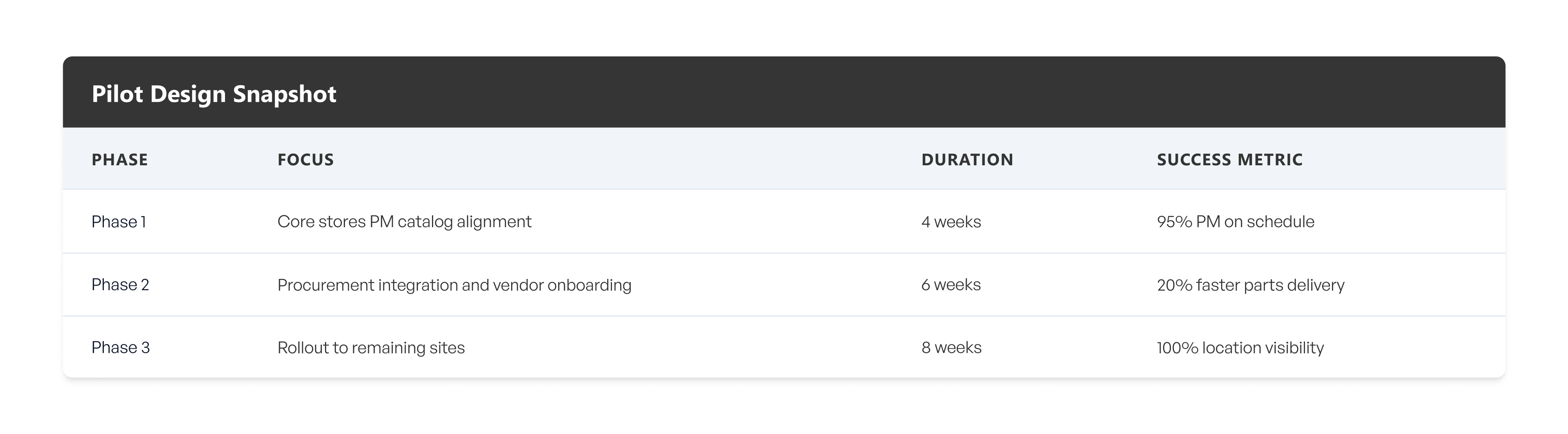
Implementation: Start with a phased rollout by region or portfolio segment (for example, core stores first, then satellites) to minimize disruption and to collect feedback for improvements.
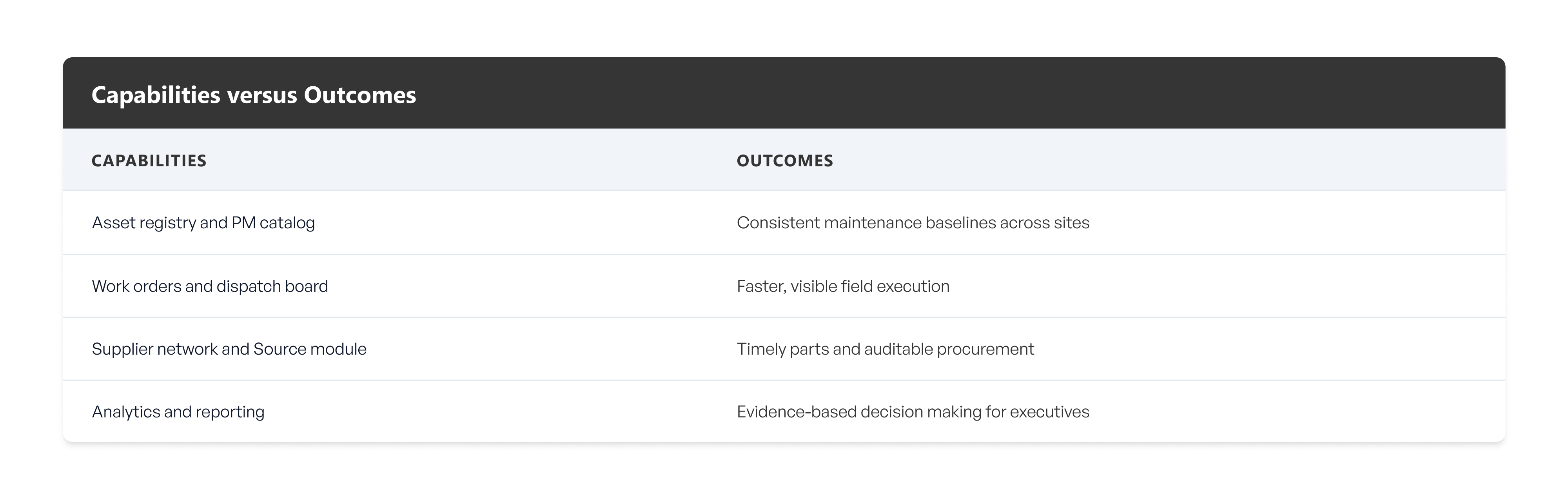
A scalable program blends standardized PM catalogs, a centralized work order engine, and a connected procurement workflow to deliver auditable service across 5 to 500 locations.
mywork delivers maintenance management at scale by anchoring a Salesforce-native CMMS with a comprehensive supplier network and procurement workflow, plus a built-in Source network of pre-vetted BSCs.
Salesforce-native differentiator
The platform is built on Salesforce Field Service, giving you native access to CRM, Einstein AI, and Tableau for advanced analytics. You gain end-to-end visibility across customers, locations, assets, and service history without juggling separate systems.
The two-sided platform advantage
For facility managers and owners, you get enterprise-grade work order management, PM scheduling, asset governance, and reporting in a single system. Also, for building service contractors, you access a robust contractor network, real-time job status, and digital proof of service for large enterprise clients.
Supply and Source modules included
Supply ties maintenance cycles to parts and services with automated replenishment and invoicing. Source provides access to 73K+ pre-vetted BSCs to fulfill outsourced maintenance tasks, with performance data attached to each contract.
Offline field capability
FieldTech Connect works offline when connectivity is limited, ensuring field teams can complete work and sync later.
Scalability and onboarding
Platform-scale credibility: 10M+ work orders processed, 190K+ locations served, 73K+ BSCs. A typical onboarding cadence for multi-site deployments demonstrates a 30 day path from project kick-off to first live maintenance cycle.
mywork is the only CMMS built natively on Salesforce Field Service, delivering native CRM, AI-enabled insights, and complete integration with the Salesforce ecosystem.
Proof points you can rely on
10M+ work orders processed across diverse verticals
190K+ North American locations serviced
73K+ pre-vetted BSCs in the network
86K field technicians on the platform to support scale
Market signal: Enterprises increasingly demand integrated procurement and contractor networks as part of digital maintenance programs to improve reliability and compliance.
A practical implementation plan helps you move from concept to steady state with guardrails and measurable outcomes.
The 30 day onboarding cadence
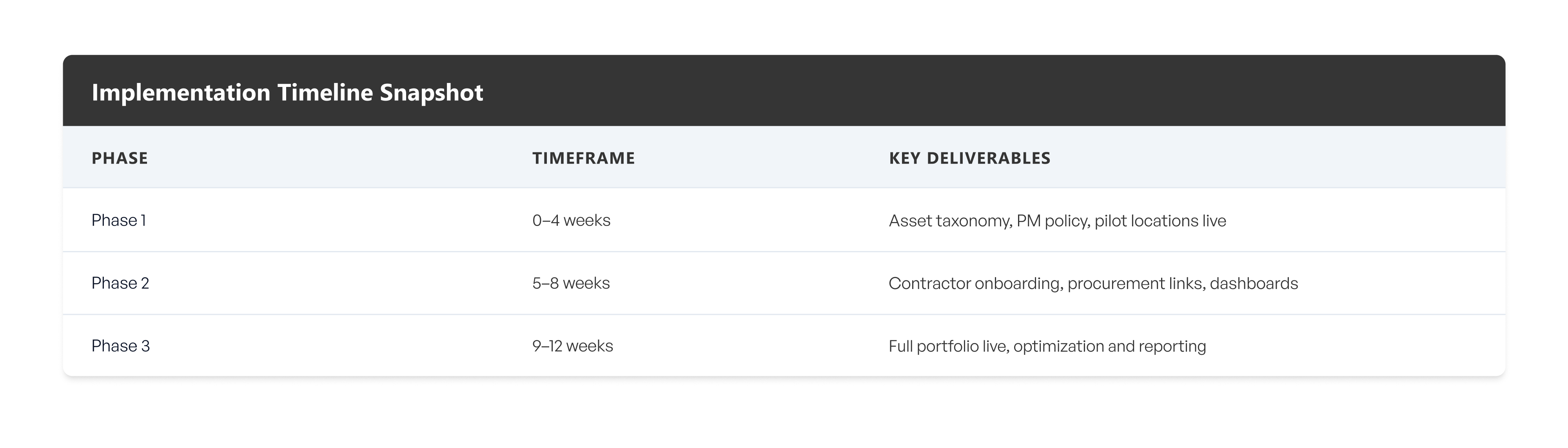
Week 1: Define portfolio scope, asset taxonomy, and PM policy
Week 2: Import assets, configure PM catalogs, onboard pilot locations
Week 3: Onboard contractors, link Source network, enable mobile workflows
Week 4: Run a go-live test, adjust dashboards, start live maintenance
Phased rollout with governance
Phase 1: Core locations with the highest asset density and downtime risk
Phase 2: Secondary locations with moderate complexity
Phase 3: Remaining sites with continuous improvement loops
Change management basics
Communicate the new process, provide role-based training, and align incentives with uptime and compliance goals. Establish a feedback loop from field teams to the central program to refine PM catalogs and workflows
Risk management
Define failure modes (data gaps, contractor misalignment, backlog during rollout) and a mitigation playbook.
Outcome anchors
On-time PM completion, reduced emergency repairs, and auditable maintenance histories across locations.
A staged rollout combined with strong change management and a 30 day onboarding benchmark enables multi-site operators to achieve steady state quickly.
Imagine a national retailer with 120 locations across several regions seeking to reduce downtime and procurement chaos while maintaining compliance. With maintenance management implemented on a Salesforce-native CMMS, the operator standardizes PM tasks across stores, integrates a unified procurement cycle for parts, and taps a pre-vetted BSC network for outsourced maintenance.
Real-time dashboards highlight high-risk sites, asset health trends, and contractor performance, enabling a proactive maintenance cadence rather than last-minute firefighting. The result is tighter control over maintenance spend, improved uptime, and auditable records that satisfy auditors and stakeholders across the portfolio.
Takeaway
A scalable maintenance management program removes the randomness from multi-site operations and provides a single source of truth for maintenance history, procurement, and contractor performance.
Market signal: Enterprises increasingly demand digital, auditable maintenance programs to demonstrate reliability and compliance across portfolios.
What is maintenance management?
Maintenance management is the systematic planning and execution of maintenance activities across multiple sites to maximize uptime and compliance.It includes the governance of work orders, preventive maintenance programs, asset data, and performance reporting to create auditable service histories.
How does a CMMS support maintenance management?
A CMMS centralizes work orders, PM calendars, asset records, and supplier interactions, providing real-time visibility, standardized tasks, and governance across locations. When properly implemented, a CMMS links maintenance tasks to procurement and contractor work, enabling faster parts delivery and consistent service quality.
What are the benefits of maintenance management at scale?
The benefits include reduced downtime, better regulatory compliance, consistent service delivery across sites, and clearer cost control through integrated procurement and contractor performance data.
How long does it take to implement a maintenance management system?
Implementation timelines vary by portfolio, but many multi-site operators achieve first live maintenance within 30 days in scalable implementations, with full adoption following in staged phases.
Is maintenance management suitable for BSCs and FM teams?
Yes. A scalable program benefits both sides: facility managers gain enterprise visibility and control, while building service contractors gain access to a reliable client network, real-time job status, and digital proof of service.
What role does procurement play in maintenance management?
Procurement ties parts and services directly to maintenance tasks, streamlining replenishment, invoicing, and supplier performance tracking as part of the maintenance lifecycle.
What makes mywork a good fit for maintenance management at scale?
mywork combines a Salesforce-native CMMS core with a built-in supply module and a large pre-vetted BSC network, delivering auditable maintenance histories, real-time visibility, and seamless integration with the Salesforce ecosystem.
Maintenance management is not simply a process; it is a strategic capability that underpins uptime, regulatory compliance, and predictable operating costs across a portfolio. With the right framework, you can move from fragmented, reactive maintenance to a scalable program that delivers auditable outcomes, a stronger supplier network, and clearer governance across all your locations.
If your team manages multiple sites and wants to transition from firefighting to preventive, a conversation with mywork is a practical next step. Schedule a demo at mywork.one/contact to explore how a Salesforce-native CMMS, combined with a robust Supply and Source network, can transform your maintenance management at scale.
Explore our latest articles, guides, and industry updates designed to help you grow smarter and scale faster.