The best CMMS for retail is a platform that centralizes work orders, asset tracking, and service provider management across multiple store locations. It helps retail operations teams reduce downtime, improve efficiency, and gain real-time visibility while enabling faster issue resolution and better customer experience.
The best CMMS for retail is not just software that tracks maintenance. It is a system designed to handle the complexity of managing multiple locations, assets, and service providers in real time.
Retail businesses operate in highly distributed environments. A single brand may manage hundreds of stores, each with critical equipment such as HVAC systems, refrigeration units, lighting, and other critical systems. Without a centralized system, maintenance can become inconsistent and reactive.
A CMMS provides a unified platform where all maintenance operations are tracked. It centralizes work orders, asset histories, preventive maintenance schedules, and service provider interactions into a single system.
Modern CMMS platforms extend beyond basic functionality. They provide automation, real-time dashboards, and integrations with financial systems, enabling retail operators to move toward proactive maintenance and operational control.
Retail operations teams often adopt a CMMS when manual processes stop scaling.
Work Order Chaos
Retail stores generate constant maintenance requests. These requests often come from emails, calls, or store managers reporting issues manually. Without a structured system, requests can be lost or delayed.
A CMMS centralizes all requests into a single system, helping ensure every issue is tracked, assigned, and resolved.
Service Provider Mismanagement and Compliance Risks
Retail businesses depend heavily on service providers for maintenance services. Managing them manually can lead to inconsistent service quality and compliance risks.
A CMMS can standardize provider onboarding, track compliance documents, and monitor provider performance.
Lack of Visibility Across Locations
Retail chains often struggle with fragmented data. Leadership teams can lack real-time visibility into store-level performance.
A top CMMS system addresses this by providing centralized dashboards across all locations, enabling better decision-making.
Retail environments require consistent uptime. Even minor failures can directly impact revenue and customer experience.
Invoice Delays and Poor Spend Visibility
Maintenance workflows are often disconnected from billing systems. For retailers, the business impact can include:
Invoice delays, approval bottlenecks, and poor spend visibility.
A modern CMMS connects work completion, documentation, approvals, and invoicing so teams can manage costs more accurately and resolve issues faster. Service teams can document their work easily and quickly, prove completion, invoice quickly, and get paid faster.

A CMMS standardizes the entire maintenance lifecycle across retail operations.
Step 1: Request Intake
A maintenance request is logged by a client, location, or internal team.
Step 2: Work Order Creation
The system converts the request into a structured work order with predetermined details.
Step 3: Triage, Approval and Assignment
The work order is reviewed, prioritized, approved if needed, and assigned to an appropriate internal technician, team, or service provider.
Step 4: Scheduling and Dispatch
The work is scheduled and dispatched so the right person or provider has the information needed to complete the job.
Step 5: Field Execution/Completion
Technicians complete work and ideally use mobile tools to update status, capture notes, add photos, record labor/materials, and document the outcome
Step 6: Review/Closeout (Verification)
Completed work is reviewed, validated, and approved and closed with a definitive record of the work.
Step 7: Reporting
The system should capture maintenance history, costs, completion times, SLA performance, asset trends, and operational data for reporting and decision-making.
This structured workflow improves accountability, efficiency, and transparency across operations
The best CMMS for retail must support distributed, provider-heavy operations.
Work Order Management
Centralized work order tracking helps ensure that all maintenance requests are captured and resolved efficiently.
Service Provider Management
A strong CMMS enables organizations to onboard service teams and technicians, track compliance, and monitor provider performance across locations.
Asset Management
Retail operations depend on critical assets such as refrigeration and HVAC systems. A CMMS provides asset history tracking and preventive maintenance scheduling, reducing downtime.
Mobile Access for Technicians
Technicians can access work orders, update progress, and capture data in real time. Mobile accessibility is important for improving technician productivity and adoption.
Multi-Site Management
Retail businesses require centralized control across locations. CMMS platforms provide standardized workflows and reporting across all sites.
Reporting and Analytics
CMMS platforms provide insights into maintenance performance, and provider efficiency, enabling data-driven decisions.
A CMMS delivers measurable operational and financial impact.
Key Benefits
CMMS platforms help organizations transition from reactive maintenance to planned, data-driven operations, and improve performance over time.

Consider a retail chain managing 150 locations.
Without a CMMS, each store often operates independently. Maintenance requests are scattered, service providers may not be vetted, work not standardized, and reporting is inconsistent.
With the best CMMS for retail, all locations are connected in one system. Providers are tracked with performance metrics, preventive maintenance reduces breakdowns, and billing is automated.
Platforms like myWork are built for this level of complexity. myWork unifies facility teams, store locations, service providers, work orders, assets, procurement, and reporting in one connected operating model across every location, through myWork Enterprise and myWork Supply. The result is an operational truth that helps retail teams improve visibility, accountability, and execution without relying on fragmented systems.
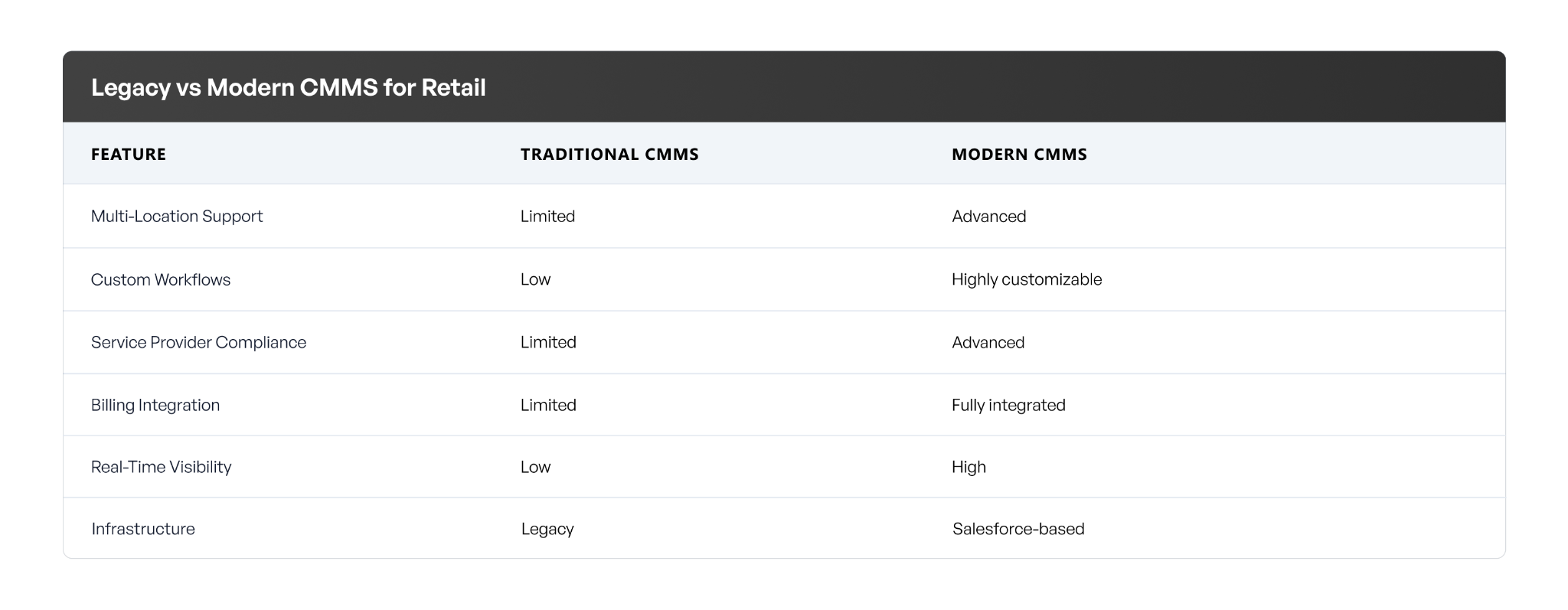
Legacy CMMS tools were designed for basic maintenance tracking. They can lack the flexibility and scalability required for modern retail operations. Common limitations include poor service provider management, limited or no customization, and lack of real-time visibility.
Modern CMMS platforms are built for scale. They connect operations end to end, automate workflows, and provide real-time insights. Platforms like myWork act as a system of record for facility operations, enabling retail businesses to manage complexity efficiently with ecosystem alignment, procurement connected to work, and field-first execution.
Choosing the best CMMS for retail is a strategic decision that directly impacts operational efficiency, uptime, and customer experience. Retail businesses need centralized visibility, provider accountability, and integrated workflows to scale effectively. The strongest platforms create one connected operating model across work orders, assets, providers, procurement, and reporting. For multi-site retail teams, myWork helps unify facility operations, reduce fragmentation, and create the visibility and accountability needed to move faster, operate smarter, and own the work.
What is the best CMMS for retail?
The best CMMS for retail is a platform that centralizes maintenance operations, including work orders, assets, and service provider management across multiple locations.
How does a CMMS improve retail operations?
It reduces downtime, improves maintenance efficiency, and provides real-time visibility across all store locations.
What industries use retail CMMS solutions?
Retail, restaurants, grocery chains, banking and other multi-location service businesses use CMMS platforms.
How long does CMMS implementation take?
Structured CMMS implementations commonly take 30 - 90 days, depending on data readiness, integrations, workflow complexity, training, and rollout scope. Core workflows can go live faster when the platform fits the operating model and the implementation is well prepared.
Is CMMS suitable for large retail chains?
Yes, modern CMMS platforms are designed to handle multi-location operations and large service provider networks.