

Across 10 locations, planned maintenance systems stop firefighting from consuming the budget. When a single breaker trips or a cooling unit fails, you don’t just lose uptime; you lose customer trust and trigger overtime costs. 90% of maintenance teams say preventive maintenance is very or extremely valuable, yet about half still plan most activities ahead of time. That disconnect costs multi-site operators millions in emergency repairs and rushed procurement every year.
This is where mywork steps in. As the only CMMS built natively on Salesforce Field Service, mywork brings native CRM, Einstein AI, and a pre-vetted building service contractor network into one platform.
This blog explains how planned maintenance systems work in practice, how to evaluate options without overpromising, and what deployed patterns look like in retail, CRE, healthcare, and BSC contexts. We’ll also highlight two actionable roadmaps that reduce risk and accelerate implementation.
Planned maintenance systems align across locations to prevent emergency repairs and reduce downtime.
A Salesforce native CMMS like mywork unlocks CRM data, AI insights, and a broad contractor network out of the box.
Expect a structured path from reactive to preventive work, including measurable improvements in on-time completion and part availability.
Procurement and supply integration strengthens control over costs and compliance across 5 to 500 locations.
Real world patterns span retail and QSR, CRE, healthcare, and BSCs, with RMS Investment Group providing a 30 day onboarding benchmark.
Planned maintenance systems coordinate schedules, parts, and field work so every location operates with consistent reliability. They turn scattered PM tasks into a shared calendar of activities, with triggers, approvals, and documentation that travel with each location.
For a facility director juggling 50 or 500 sites, the payoff is neither theoretical nor distant; it is the ability to forecast workload, allocate technicians, and prove compliance with a single audit trail.
In practice, this means calendarized preventive tasks, automated reminders, standardized work orders, and a single source of truth for equipment histories.
Centralized scheduling for multi-site PM tasks
Real time visibility of work orders across locations
Standardized checklists and mobile forms for field techs
Paperless approvals and digital proof of service
Integrated procurement for parts and subcontractor labor
Offline mobility that works where Wi Fi is unreliable
Key insight: Planned maintenance systems scale with your portfolio and reduce the cost of firefighting by turning maintenance from an episodic event into a continuous capability.
Proactive maintenance reduces unplanned downtime, extends asset life, and lowers total cost of ownership. But the gap between recognizing the value of preventive maintenance and actually implementing it can be wide.
A robust planned maintenance system gives you the guardrails to plan, track, and verify PM tasks across all locations, so a technician in one region does not become the bottleneck for another. The most successful operators treat preventive maintenance as a governance discipline, not a weekly to do list.
Predictable maintenance windows across the portfolio
Better parts planning and inventory control
Compliance-ready documentation and audit trails
Real-time status updates for executives and site managers
Data-driven optimization of maintenance cycles
Common mistake: Underestimating the importance of data quality. When asset histories are incomplete, PM scheduling is guesswork and benefits never fully materialize.
mywork is the only CMMS built natively on Salesforce Field Service. That architecture means you have a shared data layer across CRM, service operations, and analytics, plus native Einstein AI and a vast Salesforce ecosystem.
For a facility director or BSC owner, this translates to faster onboarding, better reporting, and meaningful improvements in both cost and uptime. The platform ships with a pre-vetted network of 73,000 building service contractors and a mature FieldTech Connect offline capability that keeps you productive in the field.
Enterprise scale with 10 million plus work orders processed
190,000 plus locations serviced across North America
86,000 plus field technicians on the platform
Native procurement and supply management in a single system
Edison style analytics through Salesforce and Tableau integration
Strong integration with existing ERP and procurement processes
Before adopting planned maintenance systems, many operators relied on disparate tools and this led to blind spots in vendor management and inventory control. With mywork, the needs of facility managers and BSCs converge in a single view, accelerating decision making and reducing the lag between issue identification and resolution.
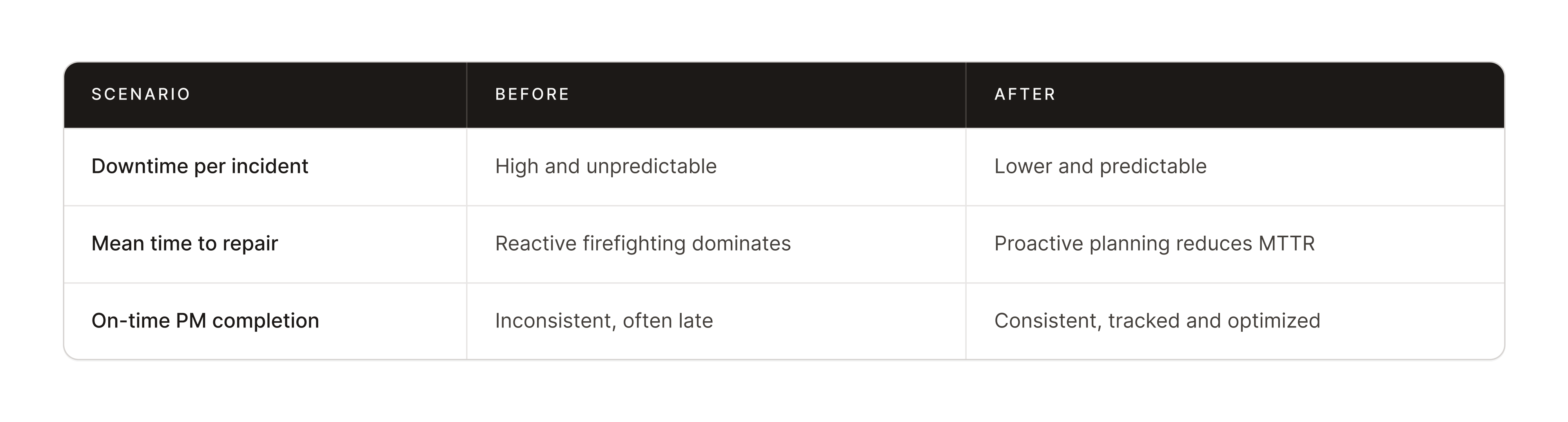
Retail and QSR operators standardize PM programs to reduce kitchen and store downtime, while CRE portfolios emphasize lease compliance and HVAC reliability across properties. Healthcare facilities prioritize infection control, patient safety equipment, and compliance documentation. Building service contractors benefit from a unified portal for scheduling, invoicing, and client reporting.
Retail and QSR: Standardized PM across kitchens, coolers, and storefronts
CRE: Centralized PM for elevators, HVAC, and lighting across campuses
Healthcare: PM for critical life safety systems plus regulatory documentation
BSC: Contractor network managed from a single dispatch board
Multi-site Operators: Governance and visibility across 5 to 500 locations
Market signal: Enterprises report a 20 to 35 percent reduction in emergency maintenance spend after consolidating maintenance programs on a single platform.
A built in procurement layer means you can source parts and labor from a curated network within the same system used to schedule and track PMs. This reduces procurement chaos, speeds invoicing, and supports stronger supplier governance.
Source: Access a vetted contractor network and approved vendors
Supply: Manage parts and materials from purchase to receipt
Services: Align external service providers with PM schedules
Audit trails: End-to-End visibility for compliance and reporting

RMS Investment Group was fully onboarded and operational on mywork within 30 days, demonstrating the speed and breadth of deployment possible for multi-site real estate portfolios. For operators already using SAP or SAP planned maintenance workflows, the question is how planned maintenance systems can integrate with existing ERP data.
A true SAP integration supports maintenance planner in SAP functionality by aligning asset records, work orders, and maintenance plans with ERP data, reducing duplicate entries and improving cross system reporting. mywork supports native data interchange and bi-directional updates to keep SAP and the CMMS in sync while preserving the integrity of asset histories and procurement records.
Fast onboarding for multi-site portfolios
Single source of truth for PM tasks and asset histories
SAP compatible workflows including maintenance planner in SAP style alignment
Consistent reporting and audit trails across locations
A successful rollout follows a staged path: define PM programs, align on the network of BSCs, deploy the core work order engine with offline mobility, and then expand to Supply and Source modules. Typical timelines range from 30 to 90 days for a mid sized portfolio, with ongoing optimization after going live.
Phase 1: Asset inventory, PM schedules, and location setup
Phase 2: Dispatch board, mobile forms, and offline field work
Phase 3: Procurement, supplier onboarding, and contract enforcement
Phase 4: Analytics, dashboards, and executive reporting
Key Insight: Operators who structure PM programs around governance and data quality see quicker benefits and higher adoption rates among field teams.
Common mistakes to avoid during deployment
Overly complex PM schedules that outpace field capacity
Incomplete asset histories that weaken PM effectiveness
Relying on manual workarounds instead of automations and alerts
Underestimating the change management needed to drive adoption
Failing to align with supplier contracts and SLAs
What is a planned maintenance system and why should our portfolio use one?
A planned maintenance system coordinates PM tasks, parts, and field work across multiple locations to reduce downtime and improve compliance. It provides a single source of truth for asset histories and a forecastable maintenance workflow.
How does preventive maintenance reduce costs for multi-site operators?
It reduces emergency repairs, extends asset life, improves inventory planning, and streamlines supplier management, which lowers total maintenance spend over time.
How long does it take to implement a planned maintenance system?
Typical time to onboard a mid size portfolio is 30 to 60 days, with larger portfolios taking longer depending on asset complexity and ERP integrations.
Is a planned maintenance system suitable for all verticals?
Yes, though the configuration varies by vertical. Retail, CRE, healthcare and BSCs benefit most when PM programs are tailored to asset criticality and regulatory requirements.
What is the ROI of moving to a planned maintenance system?
Operators commonly see reductions in emergency maintenance spend, improved on time PM completion, and faster procurement cycles which compound into lower operating costs and higher uptime.
Can planned maintenance systems integrate with SAP for maintenance planning?
Yes, SAP integration is feasible to align asset data and maintenance plans with ERP workflows, including maintenance planner in SAP style processes, while preserving CMMS data integrity.
Planned maintenance systems are not a luxury; they are a strategic capability for multi-site operators who must balance reliability, cost, and compliance across diverse locations. mywork offers a Salesforce native foundation that makes these programs easier to implement, easier to scale, and easier to measure.
If your portfolio spans 5 to 500 locations and you are ready to shift from reactive firefighting to proactive maintenance, a practical next step is to start a conversation about how to tailor a planned maintenance system to your assets, contracts, and vendors. Schedule a short discovery at mywork.one/contact.
Explore our latest articles, guides, and industry updates designed to help you grow smarter and scale faster.