Preventive maintenance is a proactive maintenance strategy where equipment is regularly inspected, serviced, and maintained to prevent unexpected failures. It helps organizations reduce downtime, extend asset lifespan, and improve operational efficiency by addressing issues before they escalate.
Preventive maintenance is a proactive approach to maintaining equipment and facilities through scheduled inspections, servicing, and repairs before failures occur.
Unlike reactive maintenance, which responds after breakdowns, preventive maintenance focuses on avoiding failures entirely. Maintenance activities are performed at predefined intervals based on time, usage, or asset condition to ensure consistent performance.
Historically, preventive maintenance relied on manual tracking methods such as spreadsheets and calendars. These approaches were difficult to scale and often led to missed schedules and inconsistent execution. Modern systems have transformed this process by automating scheduling, tracking asset performance, and integrating maintenance workflows with operational systems.
At a strategic level, preventive maintenance is not just about fixing equipment. It is about building operational reliability into everyday workflows, reducing uncertainty, and enabling predictable performance across locations.
Organizations adopt preventive maintenance when reactive approaches begin to impact efficiency, budgets, and customer experience.
Maintenance requests often originate from multiple channels including emails, phone calls, and manual reporting. Without a centralized system, these requests can become difficult to track and manage.
This can result in missed tasks, delayed responses, and lack of accountability. Preventive maintenance introduces structured workflows that help ensure certain, qualified tasks are scheduled, tracked, and completed.
Managing service providers manually becomes increasingly difficult as operations scale. Organizations can struggle with inconsistent service quality, missing compliance documents, and lack of performance tracking.
Preventive maintenance systems standardize provider onboarding, enforce compliance requirements, and provide visibility into provider performance.
As businesses expand across multiple locations, maintaining visibility can become a challenge. Leadership teams often rely on delayed reports and fragmented data.
Preventive maintenance systems provide centralized dashboards that offer real-time insights across all locations, enabling faster and more informed decision-making.
Maintenance operations are often disconnected from financial workflows.
Disconnected maintenance workflows often create invoice delays, approval bottlenecks, and poor spend visibility. A modern preventive maintenance system connects work completion, documentation, approvals, and invoicing so teams can manage costs more accurately and resolve issues faster.
Preventive maintenance follows a structured lifecycle that ensures consistency and accountability across operations.
Step 1: Identification: Maintenance needs are identified through schedules, inspections, or asset performance data.
Step 2: Work Order Creation: Tasks are converted into structured work orders with defined scope and timelines.
Step 3: Scheduling and Dispatch: Work orders are assigned to technicians or service providers based on priority, skillset, and availability.
Step 4: Field Execution: Maintenance tasks are completed, and real-time data is captured through mobile tools.
Step 5: Review, Verification. Closeout: Completed work is reviewed for quality and compliance.
Step 6: Billing and Reporting: Work is linked to invoicing and performance tracking systems.
This structured workflow helps ensure that maintenance activities are predictable, measurable, and aligned with operational goals.
A modern preventive maintenance system acts as the backbone of facility operations.
Centralized work order management helps ensure that all maintenance activities are tracked from initiation to completion. This improves accountability and reduces missed tasks.
Preventive maintenance relies heavily on accurate asset data. Systems track service history, maintenance schedules, and performance metrics, enabling better decision-making around repairs and replacements.
Organizations can onboard service providers, track compliance, and monitor provider performance within a single platform. This is important for managing large provider networks across multiple locations.
Maintenance schedules are automated based on time intervals, usage patterns, or asset conditions. This helps ensure consistency and reduces the risk of unexpected failures. The data must be available and trustworthy.
Technicians can access work orders, update progress, and capture data in real time. This improves communication and reduces delays in execution. It also captures vital info if needed such as QR codes, serial numbers and images of issues that may arise in the future based on current imagery.
Dashboards provide insights into maintenance performance, and trends. This allows organizations to make data-driven decisions and continuously improve operations.
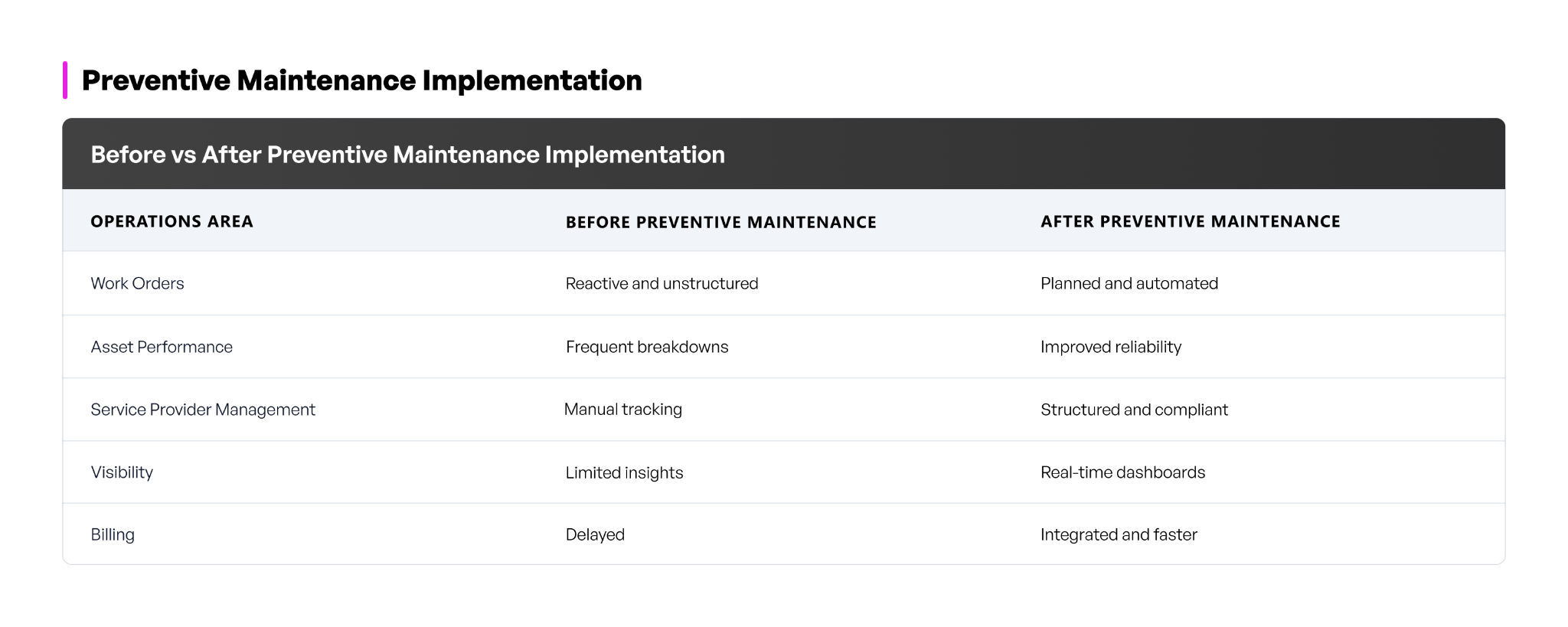
Preventive maintenance delivers significant operational and financial benefits.
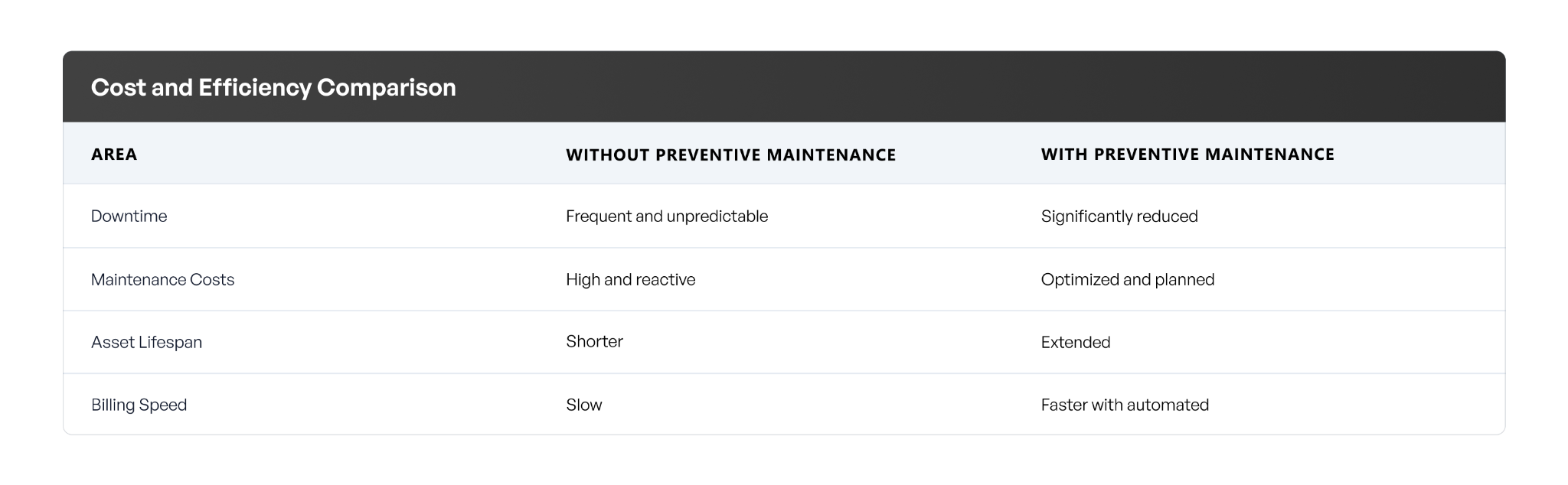
Organizations that implement preventive maintenance typically experience reduced downtime, and improved asset performance. Unplanned maintenance activities generally more often require urgent labor and higher expenses.
The less time spent reacting to unplanned issues, the more time gets spent on even more preventive activities, and so on.
Preventive strategies can also extend the lifespan of equipment, reducing capital expenditure on replacements. Improved scheduling and automation reduce administrative workload, allowing teams to focus on higher-value tasks.
Consider a retail business operating across 100 or more locations.
Without preventive maintenance, equipment failures can be unpredictable, service providers may operate inconsistently.
With a structured preventive maintenance system, maintenance activities are scheduled and more predictable. Providers are standardized, asset performance is monitored, and breakdowns are reduced. Activities also occur during off hours or peak times to prevent customer issues or revenue loss.
Platforms like myWork are built for this level of operational complexity. myWork unifies facility teams, locations, service providers, work orders, assets, procurement, and reporting in one connected operating model across every location through myWork enterprise and myWork supply. The result is an operational truth that helps teams improve visibility, provider accountability, and execution without relying on fragmented systems.
Traditional preventive maintenance relied on manual systems such as spreadsheets and calendars. These systems are difficult to scale and prone to errors.
They often lack real-time visibility, depend heavily on manual input, and may not provide actionable insights.
Modern preventive maintenance platforms address these limitations by automating workflows, integrating with other systems, and providing real-time data. They enable organizations to move from manual tracking to more intelligent, data-driven operations.
Platforms like myWork enhance this further, offering deep customization, service provider management, integrated procurement, and field-first execution built for complex, multi-location environments.
Preventive maintenance is a critical strategy for organizations looking to improve operational efficiency.
Reactive maintenance tends to lead to higher expenses, increased downtime, and operational inefficiencies. In contrast, preventive maintenance enables more predictable performance and better resource allocation.
The strongest platforms create one connected operating model across work orders, assets, providers, procurement, and reporting. For multi-site facility teams, myWork helps centralize maintenance operations, automate workflows, and create the visibility and accountability needed to move faster, operate smarter, and own the work.
What is preventive maintenance?
Preventive maintenance is a proactive strategy where equipment is regularly serviced and inspected to prevent breakdowns and extend asset life.
Which industries use preventive maintenance?
Retail, manufacturing, restaurants, healthcare, and facility management industries commonly use preventive maintenance.
How long does it take to implement preventive maintenance?
Structured implementations commonly take 30 to 90 days, depending on data readiness, integrations, workflow complexity, training, and rollout scope. Core workflows can go live faster when the platform fits the operating model and the implementation is well prepared.
Is preventive maintenance suitable for multi-location businesses?
Yes, modern systems are designed to manage maintenance across multiple locations, service providers, and assets efficiently.