Preventive maintenance is not a new idea. Most facilities teams already know it matters. The harder part is making it happen consistently across locations, assets, teams, and service providers.
That is where execution breaks down.
Emergency repairs still pile up. Budgets still drift. Audit trails still reveal missed steps, delayed work, and gaps that should have been addressed long before they became expensive.
If you manage 500, 1,000+ or even 10 locations, the pattern is familiar: work orders buried in email threads, service providers arriving without the right parts, compliance documentation that nobody remembers filing. That is reactive maintenance at scale, and it is exactly the problem CMMS platforms are built to solve.
A CMMS, or Computerized Maintenance Management System, centralizes work orders, schedules preventive maintenance, manages assets, coordinates service providers, and maintains compliance documentation across every location in a portfolio. This guide explains what CMMS is, why multi-site operators need it, what to look for in a platform, and what real-world implementation looks like. The insights here draw directly from myWork's operational experience, more than 10 million work orders processed across 190,000+ North American locations, supported by a network of 73,000+ pre-vetted building service contractors.
CMMS is a software platform that centralizes maintenance operations across multiple locations. It manages the full lifecycle of a maintenance request from the moment a problem is reported through dispatch, execution, documentation, invoicing, and reporting.
In practice, CMMS transforms maintenance from a series of ad hoc reactions into a structured, auditable, and optimized operational program. The difference between a facility team that runs on a CMMS and one that does not is often visible within weeks. Work orders stop falling through cracks. Preventive maintenance gets scheduled and completed more consistently. Service providers are accountable because performance is tracked.
What a modern CMMS does across a multi-site operation:
Key Insight: A CMMS is not a ticketing system. It is the operational spine that connects location-level demand, asset health, service provider delivery, and procurement into one view.
The real problems that drive CMMS adoption are not technology problems. They are operational problems that have outgrown the tools being used to manage them.
Work order chaos: Whether you manage 20, 200, or 2,000 locations, work requests can come in through email, text, phone, and verbal conversation. There is often no single record. Requests get lost. Service providers show up without enough information. The same asset can break twice because the first repair was never properly documented.
Service provider mismanagement: Without a unified system, provider performance can be difficult to track. You may know when something goes wrong badly enough to cause a complaint, but not which providers are consistently slow, which ones have the highest first-time fix rates, or which service categories are running over budget.
No real-time visibility: A facility director managing 50 locations across multiple states can often find it difficult to know the status of open work orders without making calls or waiting for reports. Problems can escalate because they are not caught early enough.
Invoice delays and poor spend visibility: Manual invoicing is typically slow and error-prone. Service providers submit paper invoices that require manual entry, approval routing through email, and reconciliation against work orders. The administrative overhead is significant and the error rate can be high. Disconnected maintenance workflows often create invoice delays, approval bottlenecks, and poor spend visibility. A modern CMMS connects work completion, documentation, approvals, and invoicing so teams can manage costs more accurately and resolve issues faster.
Compliance gaps: Audits require documentation. Without a system that captures maintenance records, inspection forms, technician signatures, and asset history automatically, compliance can become a scramble every time an audit is announced.
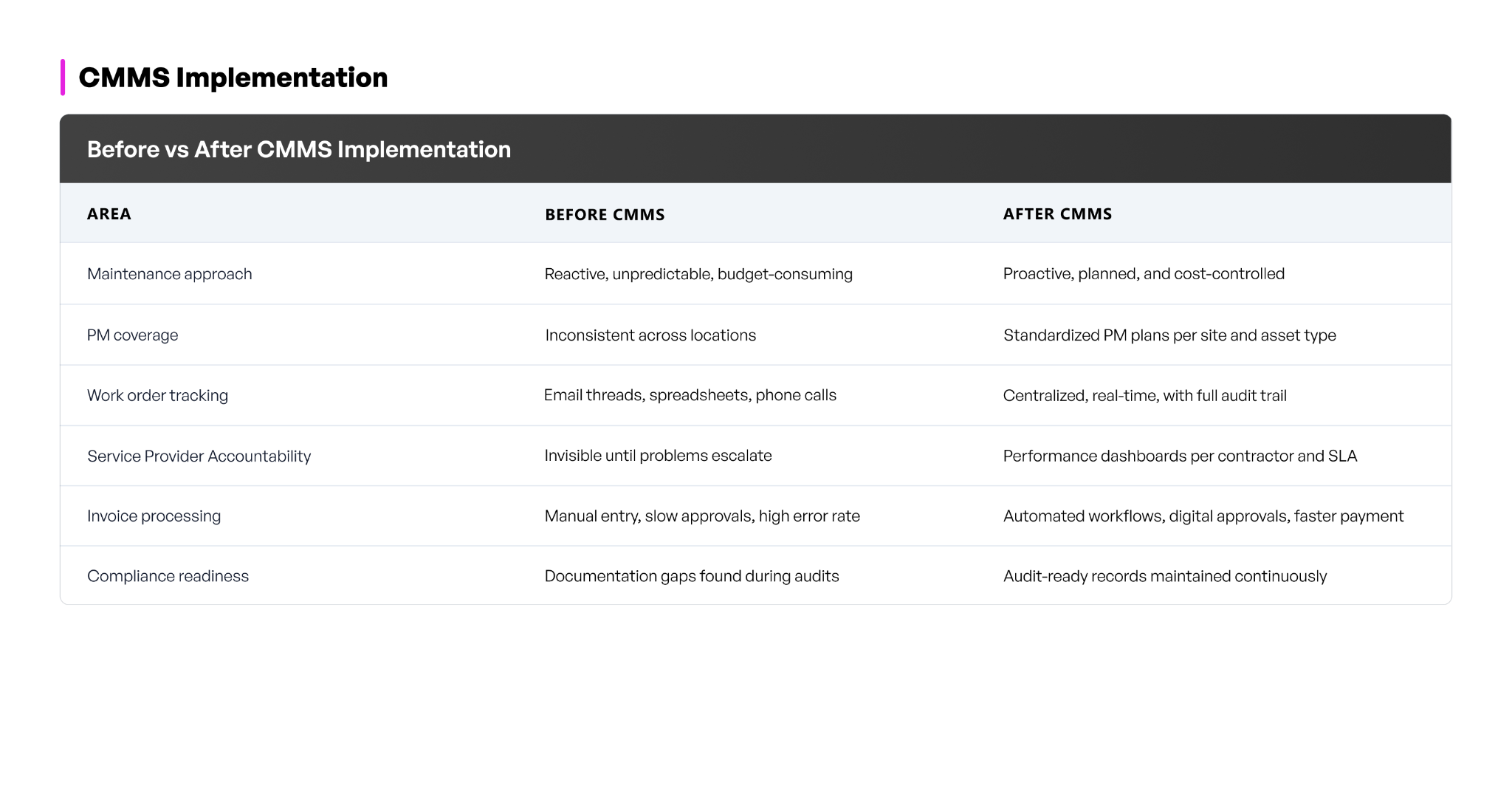
Understanding what CMMS does operationally means following a work order from start to finish. This is where the value becomes concrete.
A CMMS digitizes the full lifecycle of maintenance operations.
Step 1: Request Intake
A maintenance request is logged by a client, location, or internal team.
Step 2: Work Order Creation
The system converts the request into a structured work order with mandatory details.
Step 3: Triage, Approval and Assignment
The work order is reviewed, prioritized, approved if needed, and assigned to an appropriate internal technician, team, or service provider.
Step 4: Scheduling and Dispatch
The work is scheduled and dispatched so the right person or provider has the information needed to complete the job.
Step 5: Field Execution/Completion
Technicians complete work and ideally use mobile tools to update status, capture notes, add photos, record labor/materials, and document the outcome
Step 6: Review/Closeout (Verification)
Completed work is reviewed, validated, and approved and closed with a definitive record of the work.
Step 7: Reporting
The system should capture maintenance history, costs, completion times, SLA performance, asset trends, and operational data for reporting and decision-making.
Common Core to CMMS Platforms: The technology works best when processes, data, and people are aligned.
Not all CMMS platforms are built the same way. When you evaluate options, these are the capabilities that separate platforms that scale from ones that create new bottlenecks.
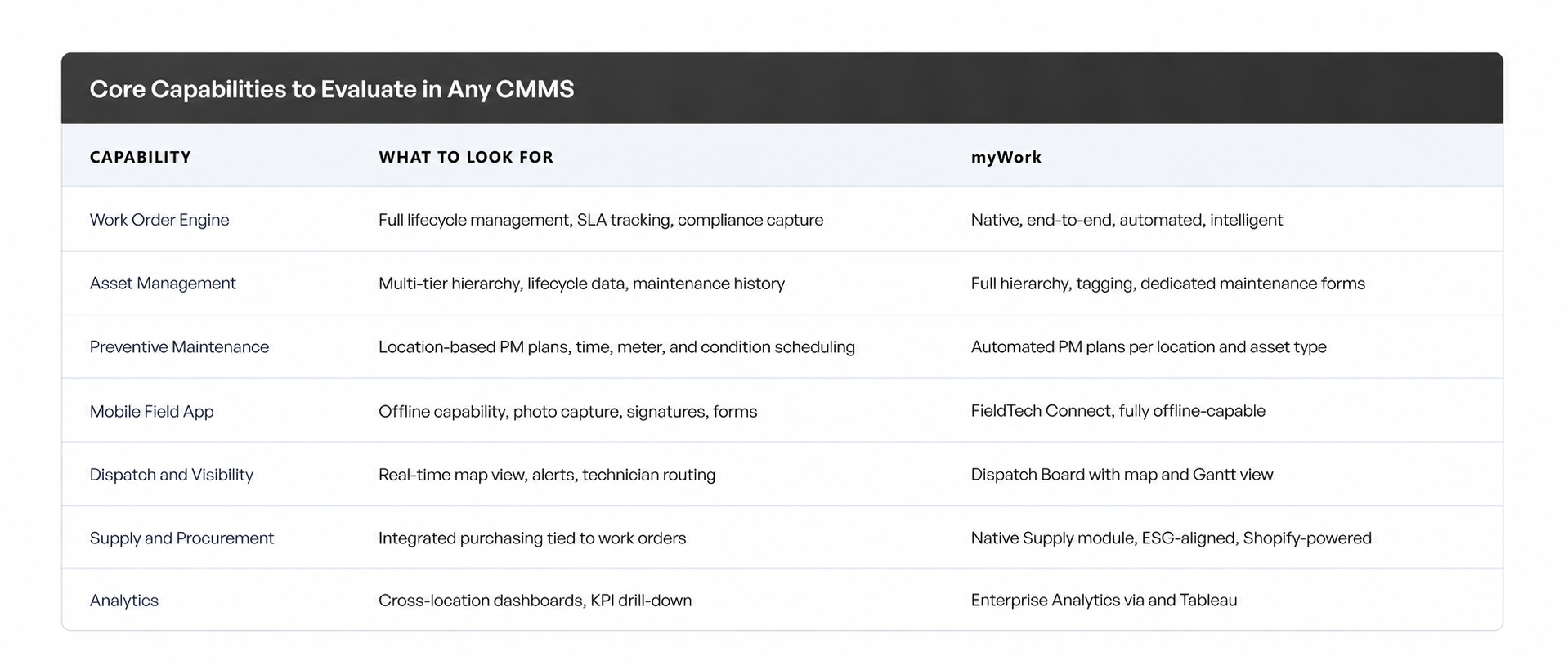
One capability that strong CMMS systems offer is the pairing of a native procurement module with a broad service contractor network. myWork offers intelligent procurement as part of the platform, meaning facility managers can assign service providers, dispatch/assign work, track performance, manage inventory, and control spend without leaving the system.
A large, fast-growing mixed-use real estate owner-operator, which manages mixed-use developments with upscale residences, national retailers, restaurants, and entertainment venues, was fully onboarded and operational on myWork within 30 days. That timeline is achievable when the architecture fits the operational need.
Market Signal: Verdantix CMMS benchmarks evaluate platforms on their ability to unify maintenance workflows with asset data, supplier networks, and procurement. myWork does this.
Choosing a CMMS is a decision that will shape your maintenance operations for years. These are the evaluation criteria that matter most depending on your scale, service provider network, and procurement complexity.
Scale and location count: Platforms that work well for 10 locations may struggle at 100. Evaluate how the platform handles location hierarchies, cross-site reporting, and PM plan templates that apply across a portfolio. myWork serves operations ranging from 5 locations to 500, to 1,000+ with 190,000+ locations already on the platform.
Service provider network size: If you work with 5 or more service providers across your portfolio, a platform with your current, vetted provider network can reduce dispatch time and improve accountability.
Procurement complexity: If your team manages supply purchasing alongside maintenance operations, a native procurement module can help close the gap between what was ordered, what was used, and what was billed. myWork integrates this directly into the platform.
Mobile and offline requirements: Field technicians working in large buildings, basements, or remote sites need tools that work without a reliable connection. myWork Enterprise includes fully offline mobile capability, a practical constraint that affects daily operations, not just a feature comparison point.
Data readiness: Implementation speed is directly tied to the quality of your existing asset data. Clean location hierarchies, asset inventories, and maintenance history records accelerate migration and reduce post-go-live issues significantly. If these are painpoints a top CMMS platform will have an implementation team to help with this.
The ROI of CMMS comes from four key operational levers: reduced downtime, lower administrative overhead, improved asset utilization, and better service provider performance.
Enterprise implementations at myWork's scale typically show short-term meaningful payback when PM adherence, downtime reduction, and admin savings are properly modeled.
A CMMS is no longer just a maintenance tool. It is a strategic platform that improves operational visibility, workflow coordination, and scalability.
It replaces disconnected tools such as emails and spreadsheets with a unified operational system.
The most effective platforms create one connected operating model across work orders, assets, providers, procurement, approvals, and reporting. For multi-site facility teams, myWork helps centralize operations, automate workflows, and create the visibility and accountability needed to move faster, operate smarter, and maintain consistency across every location.
CMMS is not optional for organizations managing maintenance across multiple locations. It is the operational infrastructure that separates teams that control their maintenance programs from teams that are controlled by them.
One platform for every team, service provider, and location across your entire facilities ecosystem. If you manage multiple locations and want to see what this looks like in practice, schedule a demo at https://www.mywork.one
What is CMMS in plain operational terms?
A CMMS is a software platform that centralizes maintenance requests, schedules work, tracks assets, coordinates service providers, and records compliance documentation across your locations. In day-to-day terms, it is the system that helps ensure every maintenance task is assigned to the right person, completed on time, documented properly, and billed correctly.
How does CMMS deliver ROI for multi-site operators?
ROI typically comes from five areas: reduced unplanned downtime through preventive maintenance scheduling and faster resolutions to work orders, lower admin overhead through automated workflows and digital invoicing, extended asset life through consistent maintenance programs, better service provider accountability through performance dashboards, and procurement savings through integrated supply management such as myWork Supply.
Which industries benefit most from CMMS?
Retail and QSR chains, commercial real estate portfolios, restaurants, healthcare facilities, and building service contractors see the highest impact. These are environments with high location density, large service provider networks, and strict compliance requirements. Companies such as Wendy's, Honeygrow, and Cushman & Wakefield operate across exactly these verticals.
How long does CMMS implementation take?
A structured deployment typically takes 30 - 90 days across discovery, migration, pilot, and initial rollout phases, depending on data readiness, integrations, workflow complexity, training, and rollout scope. Core workflows can go live faster when the platform fits the operating model and the implementation is well prepared. A large, fast-growing mixed-use real estate owner-operator was fully operational on myWork within 30 days, which reflects what is achievable with a close fit between the platform and the operational model.
Can a CMMS scale from 5 locations to 500+?
Modern enterprise CMMS platforms are built for this range. myWork serves portfolios from 5 to 500+ and over 1,000 locations with the same platform, with 190,000+ locations already active on the system. Scalable asset hierarchies, centralized PM templates, and multi-location analytics make this practical rather than theoretical.
What makes myWork different from other CMMS platforms?
myWork Enterprise incorporates myWork Supply in one integrated platform, serving both facility managers and their building service contractors in a single connected operating model that unifies work orders, assets, service providers, procurement, and reporting.